
The Rise of "Vibe Coding": How AI Agents are Changing How Web Developers Work
Introduction
For years, software development followed a predictable workflow. Developers gathered requirements, designed architecture, wrote code, tested features, fixed bugs, and deployed applications.
In 2026, a new approach has emerged across startups, indie projects, and even enterprise teams: Vibe Coding.
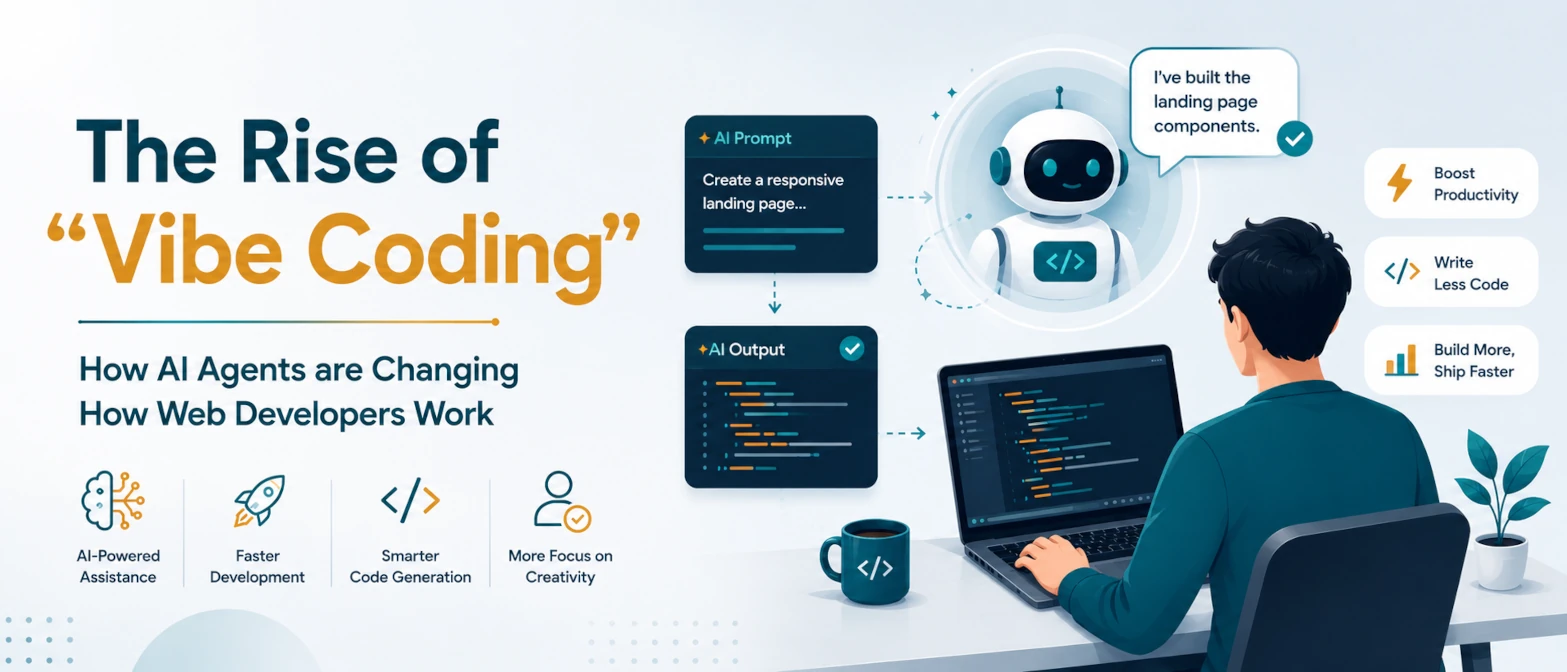
Instead of manually writing every line of code, developers increasingly collaborate with AI agents that can generate components, refactor codebases, write tests, create documentation, and even deploy applications.
The role of the developer is shifting from code producer to system designer, reviewer, and orchestrator.
This change does not mean developers are becoming obsolete. It means developers are becoming more productive than ever.
What Is Vibe Coding?
Vibe Coding is a development style where developers focus on describing goals, features, and desired outcomes while AI agents handle much of the implementation work.
A developer might say:
Create a responsive dashboard with navbar, footer, and theme-toggle buttons using Next.js, TypeScript, and Tailwind. Add authentication, charts, pagination, and dark mode support.
An AI agent can generate the initial implementation in minutes.
The developer then:
- Reviews the generated code
- Fixes edge cases
- Improves architecture
- Adds business logic
- Performs security validation
- Optimizes performance
The process feels less like programming and more like directing a highly capable junior developer.
Why Vibe Coding Is Growing So Quickly
Several trends have accelerated adoption.
1. AI Models Are Better at Coding
Modern coding models understand:
- React
- Next.js
- Vue
- Angular
- Django
- FastAPI
- Node.js
- SQL
- Docker
- Kubernetes
They can generate production-ready code for common scenarios with surprisingly high accuracy.
2. Context Windows Are Much Larger
Earlier AI tools could only understand a few files.
Modern AI agents can analyze:
- Entire repositories
- API documentation
- Database schemas
- Design systems
- Product requirements
This enables more accurate code generation and modification.
3. Agent-Based Workflows
The biggest shift is not AI chatbots.
It is AI agents.
Agents can:
- Read code
- Execute tasks
- Modify files
- Run tests
- Fix errors
- Open pull requests
Developers are increasingly managing workflows rather than writing every implementation detail manually.
How AI Agents Are Changing Daily Development
Feature Development
Traditional workflow:
- Create components
- Connect APIs
- Handle state
- Build forms
- Add validation
AI-assisted workflow:
- Describe feature
- Review generated implementation
- Refine business logic
What previously took several hours may now take minutes.
Debugging
Many developers now use AI agents as debugging partners.
Instead of manually searching documentation:
- Paste stack trace
- Explain issue
- Ask for root cause analysis
The agent often identifies problems immediately.
Examples include:
- React hydration errors
- TypeScript issues
- API integration bugs
- SQL query problems
- Deployment failures
Writing Tests
One of the most commonly skipped development tasks is testing.
AI agents make testing significantly easier by generating:
- Unit tests
- Integration tests
- API tests
- End-to-end tests
This increases overall code quality while reducing manual effort.
Documentation
Developers rarely enjoy writing documentation.
AI agents can automatically generate:
- API documentation
- README files
- Setup guides
- Architecture explanations
- Code comments
This improves onboarding and team collaboration.
The New Developer Skill Set
As AI handles more implementation work, valuable skills are changing.
System Design
Understanding architecture becomes more important than memorizing syntax.
Developers must know:
- When to use microservices
- Database design principles
- Security best practices
- Scalability considerations
AI can generate code.
It cannot reliably make business-critical architectural decisions.
Prompt Engineering
Developers are learning to communicate more effectively with AI.
A vague prompt:
Build a user dashboard.
Produces average results.
A detailed prompt:
Build a Next.js dashboard using TypeScript, server components, role-based access control, PostgreSQL, and responsive layouts.
Produces significantly better results.
The quality of instructions increasingly influences output quality.
Code Review
Generated code is not automatically correct.
Developers must review:
- Security issues
- Performance problems
- Maintainability concerns
- Architectural consistency
Strong review skills are becoming more valuable.
The Benefits of Vibe Coding
Faster Development
Projects that once took weeks can often be completed in days.
This is especially valuable for:
- Startups
- Freelancers
- Solo founders
- Small teams
Lower Barrier to Entry
Developers can experiment with unfamiliar technologies faster.
Examples:
- Learning Rust
- Building AI applications
- Deploying Kubernetes clusters
- Creating mobile apps
AI reduces the initial learning curve.
Increased Productivity
Developers spend less time on repetitive tasks such as:
- Boilerplate code
- CRUD operations
- Form generation
- Configuration files
This leaves more time for solving real business problems.
The Risks of Vibe Coding
Despite the benefits, there are significant challenges.
Security Problems
AI-generated code can introduce:
- SQL injection vulnerabilities
- Authentication flaws
- Exposed secrets
- Insecure dependencies
Never deploy generated code without review.
Technical Debt
Fast generation can create poorly structured projects.
Common issues include:
- Duplicate code
- Inconsistent patterns
- Large components
- Unclear architecture
Without discipline, development speed can lead to maintenance nightmares.
Knowledge Gaps
Some developers rely so heavily on AI that they stop learning underlying concepts.
This becomes dangerous when:
- Production systems fail
- Performance issues appear
- Security incidents occur
Understanding fundamentals remains essential.
How Professional Teams Use AI in 2026
Leading development teams increasingly treat AI as a collaborator rather than a replacement.
Typical workflow:
- Product manager defines requirements
- AI generates initial implementation
- Developers review output
- Security checks are performed
- Automated tests run
- Human approval completes deployment
The human remains responsible for final decisions.
AI accelerates execution.
What This Means for Web Developers
The future developer is not the person who writes the most code.
The future developer is the person who can:
- Design systems
- Solve business problems
- Guide AI effectively
- Review code critically
- Build reliable products
Coding is becoming more conversational.
Software engineering is becoming more strategic.
The developers who adapt will be able to build larger and more sophisticated applications with smaller teams than ever before.
Conclusion
Vibe Coding represents one of the biggest shifts in software development since the rise of modern frameworks and cloud computing.
AI agents are transforming how websites, APIs, and applications are built. They are reducing repetitive work, accelerating development cycles, and enabling developers to focus on higher-value tasks.
The most successful developers in 2026 will not compete with AI.
They will learn how to work alongside it.
As AI agents become more capable, the question is no longer whether developers should use them.
The question is how effectively they can direct them.
The future belongs to developers who can combine human judgment, creativity, and system thinking with the speed and scale of AI-powered agents.