
Google AI Mode SEO in 2026: Practical Implementation Guide
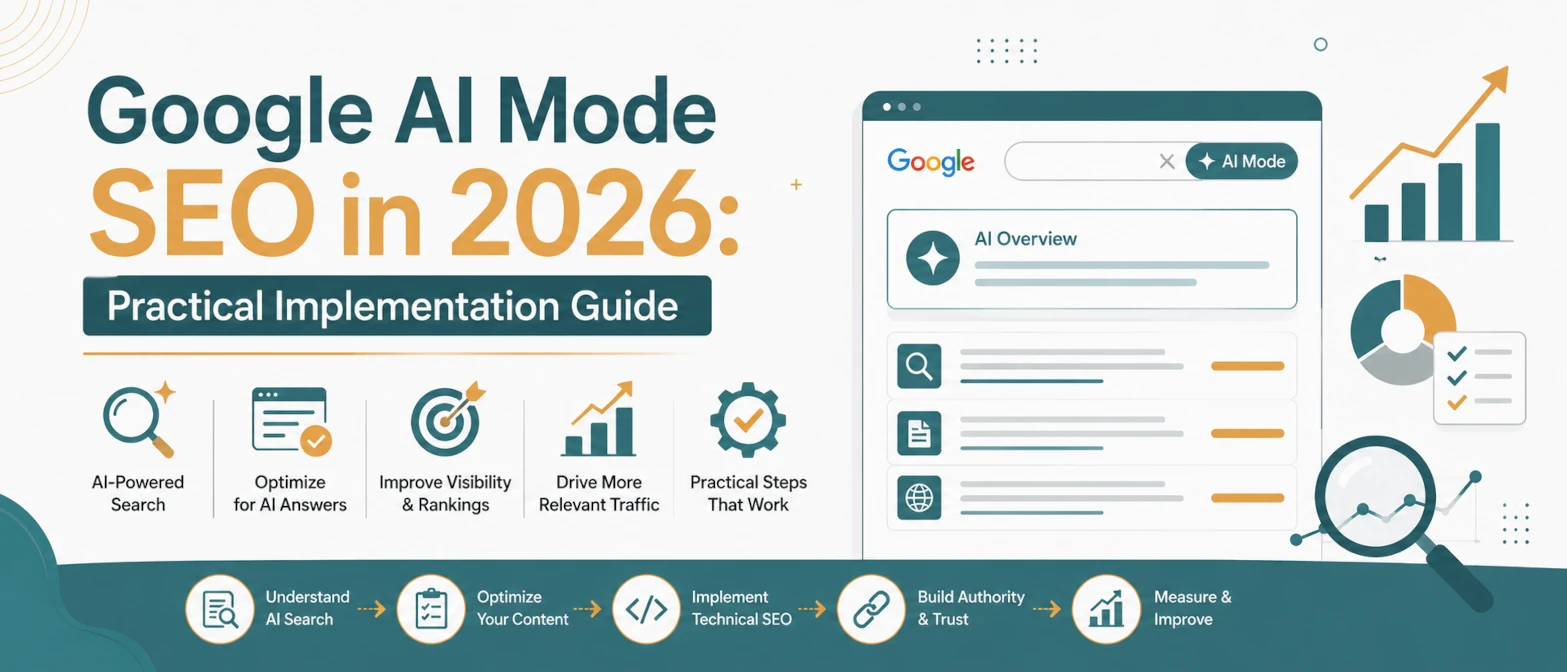
Google AI Mode changes how users discover pages. In many queries, users first see generated summaries and action workflows instead of a simple list of links. That means ranking alone is no longer enough. Pages must be easy for systems to extract, verify, and cite.
Short Answer
To prepare a page for Google AI Mode, make the main answer clear early, keep the page crawlable, use descriptive headings, add visible examples, and support the content with accurate schema and internal links. The same SEO basics still matter, but the page also needs clean answer blocks that can be used inside generated search experiences.
What AI Mode Changes for SEO
Classic SEO focused on ranking position and click-through rate from blue links. AI Mode introduces two additional requirements:
- Answer extraction: your page should contain direct, quotable answers for specific questions.
- Action confidence: your page should provide enough context that users can complete the next step safely.
Page Structure That Works Better
Use a stable section pattern so the system can map answers quickly:
- Direct definition in first 100 words.
- Step-by-step task flow.
- Concrete examples (input/output, before/after, config snippets).
- Short FAQ with unambiguous answers.
Avoid long intros, repetitive phrasing, and headings that do not match real user questions.
AEO and GEO Page Pattern
AEO (Answer Engine Optimization) and GEO (Generative Engine Optimization) both reward pages that answer a specific task cleanly. The practical page pattern is simple:
| Section | Purpose | What to Include |
|---|---|---|
| Short answer | Gives AI systems a direct summary target. | One direct paragraph that answers the primary query. |
| Steps | Shows the workflow behind the answer. | Three to six ordered steps with no filler. |
| Examples | Proves the guidance is concrete. | Input/output snippets, checklists, or before/after cases. |
| FAQ | Matches natural question-based searches. | Short questions with complete answers. |
Citation Readiness Checklist
- Use one clear H1 and descriptive H2 sections.
- Keep canonical URL correct and self-referencing.
- Ensure the page is indexable and present in XML sitemap.
- Use schema only for content that is visible on the page.
- Add recent update date when guidance changes.
Technical Workflow for TryFormatter Pages
For tool pages and guides, this workflow is reliable:
- Draft with task-first headings.
- Run internal checks using SEO Audit Tool.
- Validate index and crawl coverage with XML Sitemap Generator and Robots.txt Generator.
- Add supporting schema with JSON-LD Schema Generator.
Metadata Checks
Metadata should describe the page task, not just repeat a keyword. For AI Mode pages, check:
- Title: primary topic plus year or implementation angle.
- Description: one sentence explaining the practical outcome.
- Canonical: one stable URL with no duplicate slug variants.
- Open Graph image: a 21:9 banner that remains readable when cropped.
Example Answer Block
Each important guide should include a passage that can answer the query on its own. For example:
Question: How do I make a page easier for AI Mode to cite?
Make the main answer visible near the top, use descriptive headings, add examples, keep the page crawlable, and support the content with accurate Article, FAQ, or HowTo schema when those sections are visible on the page.
This style helps readers because they get the answer quickly. It also helps answer engines because the surrounding section explains the context and the page gives enough supporting detail to verify the statement.
Schema Rules for AI Mode Pages
Schema should describe real page content. Do not add schema types only because they may improve visibility. For technical guides, the safest schema set is usually:
- Article: for the main blog post and author information.
- BreadcrumbList: for navigation context.
- FAQPage: only when the FAQ is visible in the article body.
- HowTo: only when the page has a real step-by-step process.
Schema is not a substitute for useful content. It is a structured explanation of content that already exists on the page.
How to Measure Improvements
AI Mode visibility is not always reported as a single metric. Use practical signals instead:
- Search Console impressions for long-tail question queries.
- Click-through rate changes after rewriting titles and descriptions.
- Index coverage for new guide URLs.
- Engagement on pages with answer blocks, tables, and FAQs.
- Manual checks for whether the page appears as a useful source for target questions.
Measure these changes after publishing, then update sections that are unclear, too broad, or missing examples.
Useful Internal Links
AI search systems and human readers both need supporting context. Link to the most relevant tools when the article mentions a task:
AI Mode SEO workflow tools
Common Errors
- Writing broad opinion content without task instructions.
- Publishing short pages with no examples.
- Using FAQ schema for questions not shown in visible HTML.
- Blocking important paths accidentally via robots rules.
Official References to Check
Use official guidance before making broad SEO changes. Google's AI features documentation states that normal SEO fundamentals remain relevant for AI features, including AI Overviews and AI Mode. That means useful content, crawl access, structured pages, and accurate metadata still form the base layer.
Frequently Asked Questions
It is an extension of normal SEO. Crawlability, helpful content, internal links, and metadata still matter, but pages also need answer-ready sections that can be summarized and cited.
No. Schema helps search systems understand page structure, but visibility depends on usefulness, trust, crawl access, query intent, and whether the answer is clear.
Add a short, direct answer near the top of the page, then support it with steps, examples, and a visible FAQ.
Review important technical pages when Google changes search features, when tool behavior changes, or when examples become outdated.
Conclusion
AI Mode optimization is mostly disciplined technical writing plus crawl hygiene. Publish pages that answer one problem clearly, include concrete steps, and keep metadata and indexing signals clean.