
The Evolution of JSON: From Simple Data Format to Modern DevOps Power
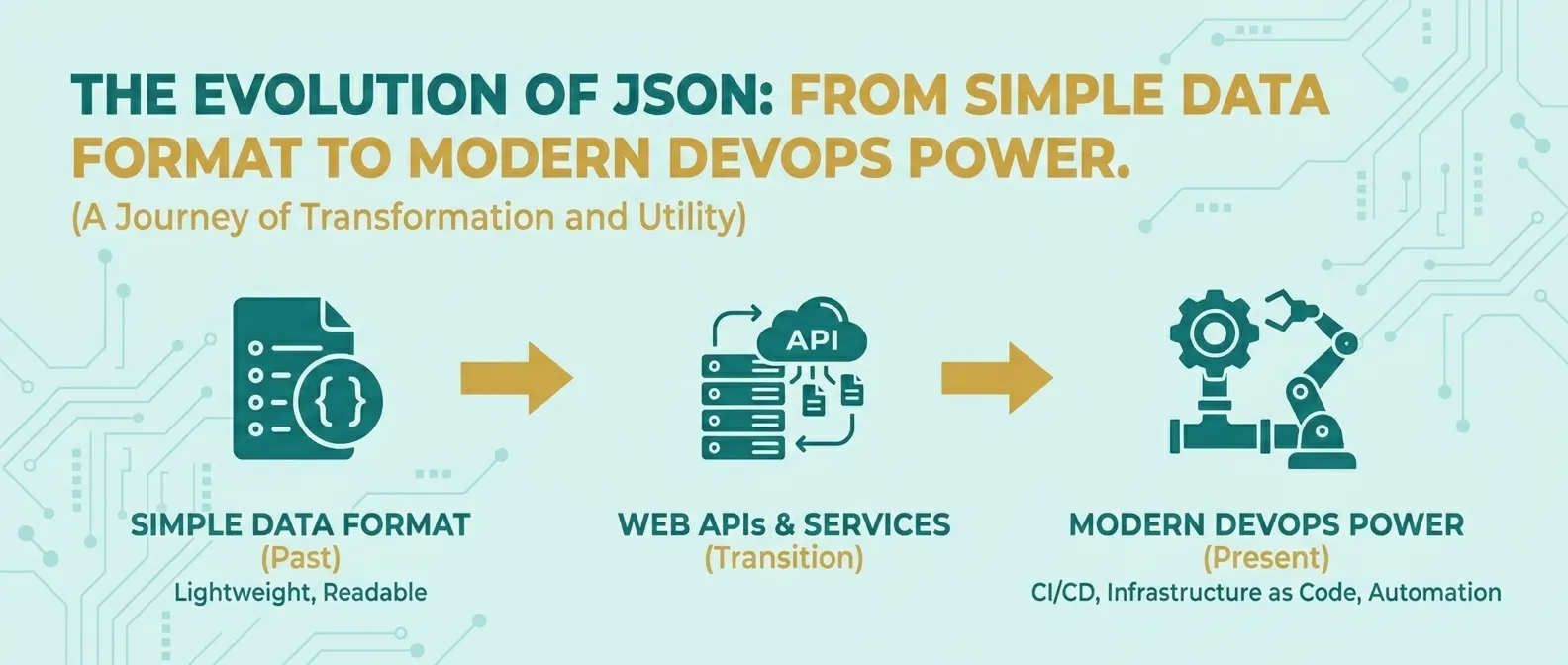
JSON started as a lightweight data notation for browser-era web apps. Over time, it became the default language for APIs, cloud automation, CI pipelines, and service integrations. In modern engineering teams, JSON is not just a transport format. It is an operational contract that connects systems across backend services, frontend clients, and infrastructure workflows.
This guide explains how JSON evolved, why it displaced XML in many workflows, and how teams can use secure, local-first tools to validate and transform JSON without exposing sensitive payloads.
Short answer
JSON became dominant because it is readable, language-neutral, and easy to parse at scale. In 2026, it powers API responses, policy definitions, cloud templates, and observability pipelines. The best practice is to combine strict schema validation, conversion workflows, and browser-local tooling so private data stays on your device during debugging.
From XML-heavy workflows to JSON-first systems
Early web services relied on verbose XML with complex namespaces and parser overhead. JSON reduced ceremony by offering a concise object model with straightforward nesting. This simplicity lowered integration cost across languages and accelerated API development.
Why JSON won
- Human readability: easy to inspect during debugging.
- Language support: universal parsing libraries.
- API alignment: natural fit for REST and modern frontend apps.
- Tooling ecosystem: rich validators, formatters, and converters.
JSON in modern DevOps
In current stacks, JSON is embedded in multiple operational layers:
- Service-to-service payload contracts.
- CI/CD configuration fragments and policy objects.
- Cloud provider API requests and responses.
- Logs, traces, and telemetry export structures.
Because these flows are machine-critical, malformed JSON can break deployments, invalidate policy checks, or hide incident context.
Essential JSON engineering patterns
1. Validate before deploy
Use schema validation to enforce required fields, types, and nested constraints before runtime.
2. Keep contracts versioned
When payload shape changes, version contracts and keep migration windows explicit.
3. Separate source and output
Store formatted source JSON for readability; generate minified output for transfer efficiency.
4. Normalize conversion paths
For data pipelines, standardize JSON-to-CSV, JSON-to-YAML, and JSON-to-XML paths with validation gates.
Examples
1. API regression prevention
Problem: optional field accidentally removed in release.
Fix: schema validation in CI blocked deployment before production.
2. Incident log enrichment
Problem: inconsistent log event shape across services.
Fix: unified JSON schema with required keys for correlation.
3. Reporting export pipeline
Problem: raw API payload difficult for business review.
Fix: JSON-to-CSV conversion with flattened field mapping.
Security and privacy considerations
JSON payloads can contain tokens, IDs, emails, and internal service metadata. Pasting these into random upload tools introduces unnecessary risk. A browser-local workflow keeps validation and formatting on-device, reducing leakage exposure.
Migration strategy for legacy teams
Teams moving from XML-heavy systems to JSON-first APIs should use controlled migration phases:
- Map existing contract fields and identify canonical JSON structure.
- Introduce dual-format compatibility for transition windows.
- Validate payload parity with schema tests and sample replay.
- Deprecate legacy paths only after monitoring stability.
This avoids disruptive rewrites and keeps integration partners aligned.
Operational anti-patterns to avoid
- Embedding secrets directly in JSON configs.
- Skipping schema versioning in multi-team environments.
- Relying only on runtime validation after deployment.
- Copy-pasting private payloads into unknown online tools.
Future direction
Even as binary protocols and specialized encodings grow, JSON remains the collaboration format most teams can read, review, and debug quickly. Its long-term value is not only technical efficiency. It is shared understanding across engineering, QA, operations, and business workflows. Organizations that treat JSON contracts as product interfaces, not incidental blobs, usually deliver more stable systems.
TryFormatter JSON toolkit
Secure JSON workflow
Frequently asked questions
Not always. XML still fits some document-heavy and namespace-centric systems, but JSON is usually simpler for modern API and app workflows.
No. Keep readable source in git. Minify at output or transport stages when needed.
Validation catches structural errors early and prevents runtime failures caused by malformed payloads.
Yes for many workloads, depending on device memory and browser limits. For very large files, process in chunks.
Conclusion
JSON evolved from a convenient notation to critical infrastructure glue. Teams that combine schema discipline, clear conversion workflows, and privacy-first local tooling can ship faster with fewer production surprises.