
Why Every Website Needs an AI-Readable Metadata Layer in 2026
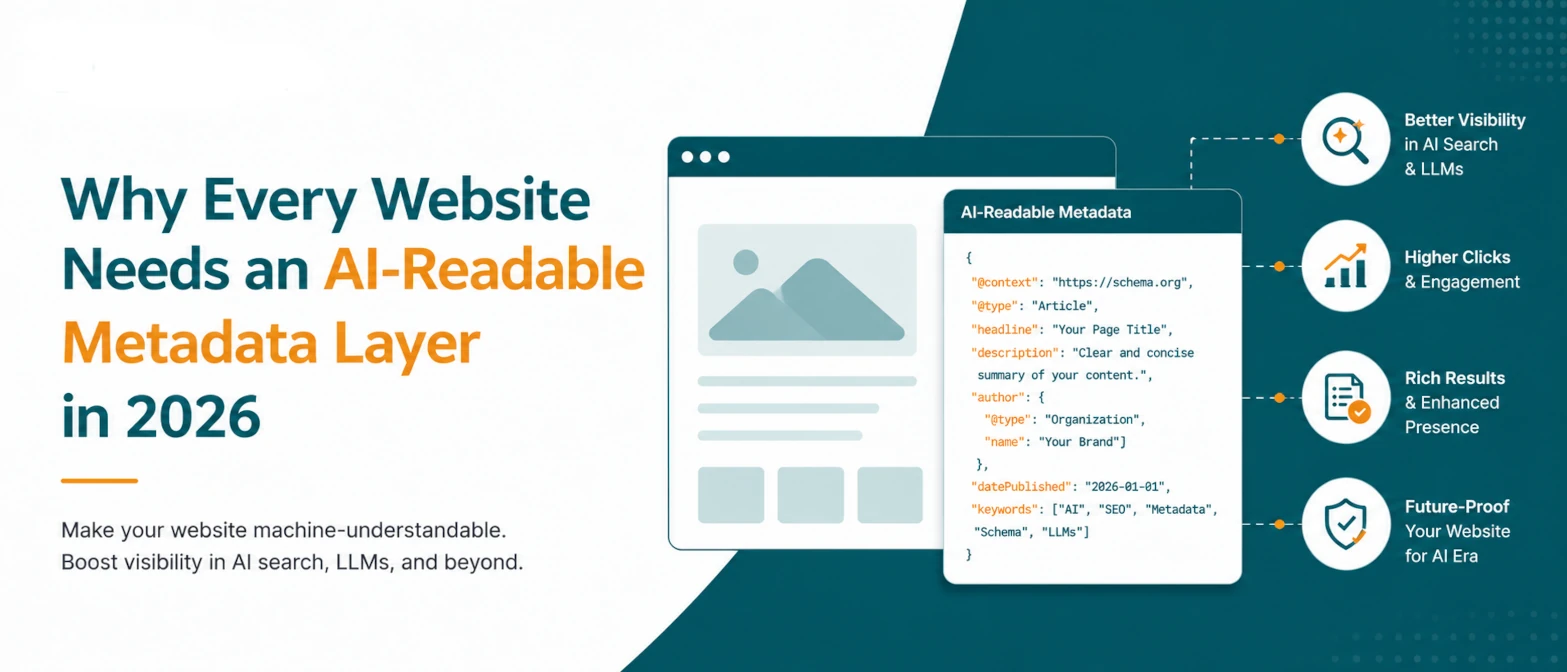
As we navigate through 2026, the entire landscape of search engines, content discovery, and online traffic generation has fundamentally shifted. For over two decades, webmasters, developers, and SEO professionals optimized websites primarily for human readability and traditional keyword density. The goal was simple: rank high on a Search Engine Results Page (SERP) so a human could click a blue link, land on your page, and read your content. Today, however, your website's audience is strictly divided into two distinct categories: human users who visually read your content, and advanced AI agents—such as ChatGPT, Gemini, Claude, and Perplexity—that programmatically consume, synthesize, summarize, and cite it on behalf of the user.
To succeed and thrive in this new era of Generative Engine Optimization (GEO) and AI Search, your website requires much more than just a beautiful frontend and a mobile-responsive design. It needs a robust, machine-consumable architecture under the hood. This is precisely why an AI-readable metadata layer is no longer an optional luxury for technical SEO enthusiasts—it is the absolute foundation of modern search visibility, traffic acquisition, and digital authority. Without it, the incredibly smart but strictly logical bots that crawl the web will fail to understand the nuances of your business, your products, and your expertise.
What Changed After AI Search: From Indexing to Answering
To fully appreciate why an AI-readable metadata layer is necessary, we must first look at how the fundamental paradigm of search has changed. Traditional search engines operated primarily as "indexers." They would send out automated crawlers to download a web page, parse the HTML, look for keyword matches in the title tags and body copy, analyze the backlink profile, and then serve a ranked list of URLs to the user based on perceived relevance. The heavy lifting of reading, comparing, and synthesizing the information was entirely left to the human searcher.
AI search, on the other hand, operates as a comprehensive "answer engine." Systems like Google AI Overviews, OpenAI's SearchGPT, and Perplexity do not just index your content to provide a link; they actively read, synthesize, and generate original conversational answers based on multiple disparate sources across the web in real-time. When a user asks a complex, multi-part question—such as "What are the best privacy-focused web formatters that don't upload data?"—the AI scours its indexed knowledge base, retrieves the most relevant chunks of text from various domains, and pieces them together into a coherent response. Crucially, it usually accompanies this generated answer with citation links back to the original source.
This introduces a massive and unprecedented challenge for websites that are purely designed for visual aesthetics. If your website's core data—such as product prices, author credentials, step-by-step instructions, or technical specifications—is locked away in unstructured paragraphs, deeply nested React states, complex interactive elements, or ambiguous HTML tags, the AI crawler cannot confidently extract the facts. Because large language models (LLMs) are designed with strict guardrails to minimize hallucinations and provide accurate information, they will simply bypass your ambiguous content. Instead, they will extract data from a competitor whose information is clearly, explicitly, and semantically structured. In the AI era, citations are the new currency, and you cannot earn a citation if the AI cannot parse your facts.
Difference Between robots.txt, sitemap.xml, and llms.txt
Understanding the modern crawler toolkit is essential for controlling exactly how your site is digested by both traditional search engines and modern AI bots. For years, webmasters relied on just two primary files to guide automated bots. Now, there is a third critical component that has become an industry standard.
Here is a detailed breakdown of these three essential files, exploring their unique purposes and target audiences, followed by a practical comparison table for quick reference:
- robots.txt: This is the traditional gatekeeper of the internet. It exists at the root of your domain (e.g., yoursite.com/robots.txt) and tells automated crawlers—like Googlebot, Bingbot, or OpenAI's GPTBot—which URLs or directories they are allowed to access and which they should explicitly ignore. It handles access control, not content understanding. It prevents crawlers from wasting resources on admin panels or duplicate content. You can generate a compliant file tailored to your needs using our Robots.txt Generator.
- sitemap.xml: If robots.txt is the gatekeeper, the sitemap is the map. It provides search engine indexers with a machine-readable XML list of all the important, indexable URLs on your site. This helps crawlers discover new pages that might not be easily accessible via internal links, understand the relative priority of URLs, and see exactly when pages were last updated via the
<lastmod>tag. You can easily build one using our Sitemap Generator. - llms.txt: This is the new standard specifically designed for the AI era. Placed at the root of your domain alongside the robots.txt file, the
llms.txtfile provides a clean, markdown-formatted summary of your site's overall structure, key documentation, rules of engagement, and intended usage explicitly tailored for Large Language Models. It tells the AI exactly what the site is about, what kind of data it contains, and how to navigate it before the bot even begins to parse the complex HTML of individual pages. This proactive summarization significantly reduces the cognitive load on the AI. Create yours today with our LLMS.txt Generator.
| File Type | Primary Purpose | Target Audience | Related Tool |
|---|---|---|---|
| robots.txt | Controls access and crawling permissions | Traditional crawlers (Googlebot, GPTBot) | Robots.txt Generator |
| sitemap.xml | Provides a map of all important URLs | Search engine indexers | Sitemap Generator |
| llms.txt | Summarizes site structure and intent in markdown | LLMs and AI agents (ChatGPT, Claude) | LLMS.txt Generator |
ChatGPT vs Gemini vs Claude vs Perplexity
Not all AI search engines and LLMs process website data in the exact same way. Some rely heavily on real-time web search capabilities to pull in the freshest data, while others prioritize structured data schemas or their own internal training cutoffs. Understanding how the major players operate helps you tailor your AI-readable metadata layer effectively across different ecosystems.
| System | Uses Search | Uses Structured Data | Citations |
|---|---|---|---|
| ChatGPT | Yes | Yes | Yes |
| Gemini | Yes | Yes | Yes |
| Claude | Sometimes | Yes | Limited |
| Perplexity | Yes | Yes | Heavy. Avoid claims that are too absolute |
As the table illustrates, platforms like Perplexity are built from the ground up as citation-heavy answer engines, making them highly reliant on structured data to verify facts before linking to your site. ChatGPT and Gemini heavily utilize real-time search capabilities, parsing your live metadata to synthesize dynamic answers. Claude, while sometimes more restrictive with external web search depending on the specific interface or API used, still highly values well-structured text when it does ingest web data.
How AI Crawlers Discover and Parse Content
When you understand the underlying mechanics of how an AI crawler explores the web, you can better optimize your architecture for it. AI crawlers, such as OAI-SearchBot (OpenAI), ClaudeBot (Anthropic), or Google-Extended, operate strictly on the principle of the "path of least resistance." They are processing millions of pages every minute, so computational efficiency and rapid ingestion are their top priorities.
When an AI crawler lands on your page, it typically strips away the heavy CSS styling and ignores complex JavaScript execution layers unless absolutely necessary. It is looking for the raw, semantic text payload. It prioritizes HTML5 tags that explicitly convey structural meaning—such as <article>, <main>, <section>, <nav>, and hierarchical headers from <h1> down to <h6>. Before it even begins to read the body content, it immediately scans the <head> of your HTML document for critical metadata signals.
If your title tags, meta descriptions, open graph tags, and canonical links are missing, vague, or dynamically injected too late in the page rendering lifecycle, the AI struggles to categorize the page's core intent. It will not spend extra computational power or time trying to guess what your page is fundamentally about; it will just move on to the next URL in its queue. Using a dedicated Meta Tag Generator ensures that your foundational HTML signals perfectly align with what the AI expects to see upon its very first parse, establishing immediate trust and context.
Structured Data: The Dictionary for AI Agents
If the llms.txt file serves as the high-level introduction to your website, structured data acts as the detailed, highly specific dictionary. JSON-LD (JavaScript Object Notation for Linked Data) has definitively emerged as the most critical component of an AI-readable metadata layer in 2026.
By injecting JSON-LD schema directly into your HTML, you explicitly define entities, relationships, and granular facts in a standardized vocabulary (typically Schema.org) that machines instantly understand without needing complex Natural Language Processing (NLP) inference. For example, if your blog post mentions "Apple," a human contextually knows whether you are talking about the multinational technology company or the red fruit. An AI might have to expend processing power to guess based on surrounding words. But with JSON-LD, your schema explicitly declares the entity as an Organization with the corporate ticker symbol AAPL.
Whether you are publishing detailed Frequently Asked Questions, comprehensive product reviews, dynamic e-commerce pricing, or step-by-step how-to guides, schema removes all semantic ambiguity from your content. You can easily build these machine-readable definitions without writing code from scratch by using a JSON-LD Generator.
Real Examples: How to Structure Your Data for AI
To make this abstract concept entirely concrete, let's look at exactly what AI-readable metadata looks like in practice. The overarching goal is to provide a clean, unambiguous JSON payload that an AI crawler can instantly ingest, parse, and verify.
Example: Article Schema for AI Search
This snippet tells the AI exactly what the page is, who wrote it, when it was published, and what the primary headline is, all without the AI needing to parse the visual DOM or read the surrounding CSS.
{
  "@context": "https://schema.org",
  "@type": "Article",
  "headline": "Why Every Website Needs an AI-Readable Metadata Layer"
}
Example: FAQ Schema for Direct AI Citations
If you want Perplexity, ChatGPT, or Google AI Overviews to cite your answers directly in their conversational responses, FAQ schema is one of the most powerful tools available. It explicitly pairs common questions with authoritative, verified answers, making it irresistible for an answer engine looking for factual data.
{
  "@context": "https://schema.org",
  "@type": "FAQPage",
  "mainEntity": [{
    "@type": "Question",
    "name": "What is an AI-readable metadata layer?",
    "acceptedAnswer": {
      "@type": "Answer",
      "text": "An AI-readable metadata layer is a combination of semantic HTML, JSON-LD structured data, and AI-specific files like llms.txt that allow AI agents to parse, understand, and cite a website's content accurately."
    }
  }]
}
Example: Breadcrumb Schema for Site Architecture
Breadcrumb schema helps AI crawlers understand the hierarchy and organizational structure of your website. It provides a logical path that contextualizes where a specific page lives within your broader topical cluster.
{
  "@context": "https://schema.org",
  "@type": "BreadcrumbList",
  "itemListElement": [{
    "@type": "ListItem",
    "position": 1,
    "name": "Home",
    "item": "https://www.tryformatter.com/"
  },{
    "@type": "ListItem",
    "position": 2,
    "name": "Blog",
    "item": "https://www.tryformatter.com/blog"
  },{
    "@type": "ListItem",
    "position": 3,
    "name": "AI-Readable Metadata Layer"
  }]
}
Common Implementation Mistakes to Avoid
Even highly experienced and well-intentioned developers often make critical errors when attempting to build an AI metadata layer. Here are the most common pitfalls you must actively avoid to ensure your site remains visible:
- Over-reliance on Client-Side Rendering (CSR): If your essential metadata, title tags, and structured data require complex JavaScript to render in the browser, fast-moving AI crawlers may miss it entirely. Many bots, especially new or smaller AI agents, do not execute JavaScript in order to save computational resources. Your critical metadata and JSON-LD must be present in the initial HTML payload sent by the server (utilizing Server-Side Rendering or Static Site Generation).
- Contradictory Semantic Signals: Having a title tag that states one topic, an
<h1>tag that says another, and JSON-LD schema that describes something entirely different will fundamentally confuse the AI model. When confidence scores drop due to conflicting data, the AI will exclude your site from its generated answers to avoid providing incorrect information, resulting in dropped citations. Consistency across all tags is paramount. - Ignoring Markdown Deliverables: LLMs are fundamentally trained on text, and they inherently prefer markdown. Failing to provide clean, markdown-friendly versions of complex data—such as large HTML tables, dense statistical charts, or intricate formatting—makes it incredibly difficult for LLMs to ingest your statistics accurately. Providing an alternative markdown view or using clean, semantic
<table>structures is crucial for data ingestion. - Keyword Stuffing in Schema: While human-facing keyword stuffing is an old and outdated SEO sin, attempting to stuff keywords inside hidden JSON-LD schema is just as detrimental today. AI agents are highly sensitive to manipulation and can easily detect anomalous language patterns. Keep your structured data strictly factual, literal, and directly representative of the visible content on the page.
The Anatomy of an AI-Optimized Page in 2026
Building a page that appeals to both human readers and AI agents requires a layered approach. The visual layer must remain engaging, fast, and accessible, while the invisible metadata layer must be clinically precise. The anatomy of such a page involves starting with a clear, descriptive URL slug, followed by a server-rendered <head> block containing exact meta titles, descriptions, and canonical tags.
Moving into the <body>, the content must be wrapped in semantic HTML5. The primary topic is declared with a single <h1>, while supporting concepts are nested logically within <h2> and <h3> tags. Importantly, the JSON-LD schema block, usually placed near the closing </body> or within the <head>, mirrors this exact structure in a machine-readable format, providing a dual-signal of truth to the crawler.
AI-Readable Website Checklist
To ensure your site is fully prepared for the 2026 AI search landscape and beyond, verify these essential elements across your domain:
- Clean Semantic HTML: Ensure the proper, logical use of header hierarchies (H1 to H6) and semantic wrappers (nav, article, aside, footer) to define document structure.
- Comprehensive JSON-LD: Implement accurate Schema.org vocabulary for Articles, FAQs, Products, Local Businesses, and Breadcrumbs on all relevant pages.
- Standardized Meta Tags: Write clear, descriptive, and non-clickbait titles and meta descriptions on every single route to establish immediate intent.
- An Active
llms.txtFile: Publish a root-level markdown file that acts as a comprehensive guide for LLM agents, outlining your site architecture and key data locations. - Updated XML Sitemap: Maintain a dynamic, error-free sitemap submitted to all major search consoles to guarantee rapid discovery of new and updated content.
Frequently Asked Questions
As the rapid transition to AI-dominated search accelerates, we hear many of the same questions from developers, content creators, and marketers. Here are the detailed answers to the most common queries regarding AI metadata.
Does llms.txt improve Google rankings?
Directly, no. Google has not stated that the presence of an llms.txt file is a direct ranking factor for traditional ten-blue-links search results. However, indirectly, it is highly beneficial. By providing a clean, markdown-based summary of your site, you make it significantly easier for Google's AI Overviews and Gemini-based crawlers to understand your overall topical authority and site structure. Better understanding leads to higher confidence algorithms, which can absolutely increase your chances of being cited in prominent AI-generated answers.
Is llms.txt a replacement for robots.txt?
Absolutely not. They serve entirely different, albeit complementary, purposes. robots.txt is a strict access control protocol that tells automated bots what they are allowed to crawl and what they are forbidden from touching for security or efficiency reasons. llms.txt, conversely, is an informational guide that summarizes content and provides deep context for AI agents that are already allowed to crawl the site. To maintain a healthy technical SEO profile, you need both files.
Do ChatGPT and Claude use llms.txt?
Yes. The llms.txt standard was specifically created because AI developers recognized the urgent need for a standardized way to ingest site documentation and context efficiently. While it is still a growing standard, crawlers associated with OpenAI (ChatGPT), Anthropic (Claude), and other major LLM providers actively look for this file to quickly grasp the context of a domain without having to computationally scrape and parse hundreds of individual HTML pages.
Should every website have structured data?
Yes, without a doubt. Regardless of your industry or niche, structured data is essential. If you run a local brick-and-mortar bakery, LocalBusiness schema tells the AI your exact opening hours, address, and phone number. If you run a SaaS technical blog, Article and FAQ schema ensure your tutorials are cited correctly when a developer asks a coding question. Structured data translates ambiguous human language into a definitive, queryable database format that AI agents explicitly trust.
Can AI crawlers read JavaScript-rendered content?
While some advanced, well-funded crawlers (like Googlebot) have highly sophisticated rendering engines that can execute JavaScript to see the final DOM, many AI-specific crawlers operate with strict computational resource limits. They will not wait for complex client-side rendering (CSR) to finish. To absolutely guarantee that AI agents can read your content, your critical text, metadata, and JSON-LD should always be delivered in the initial HTML payload directly from the server.
The Future of Machine-Consumable Websites
The World Wide Web is rapidly transitioning from a human-only visual interface to an API-driven, agent-navigated ecosystem. In the near future, users will rarely browse through ten different browser tabs to compare product specifications, read disparate tutorials, or manually extract pricing data. They will simply ask a personalized AI agent to do the heavy lifting for them, synthesizing the data into a single, comprehensive response.
Websites with strong metadata and structured content are more likely to be accurately interpreted, cited, and surfaced by AI-powered search systems. Conversely, sites that rely solely on visual design while completely neglecting their underlying data architecture will struggle to gain visibility in generative engine responses. By building for the machine today, you ensure that the machine will reliably deliver the human audience to your business tomorrow.