
Mastering the "Semantic Mesh": How Internal Linking Shapes AI Bot Discovery
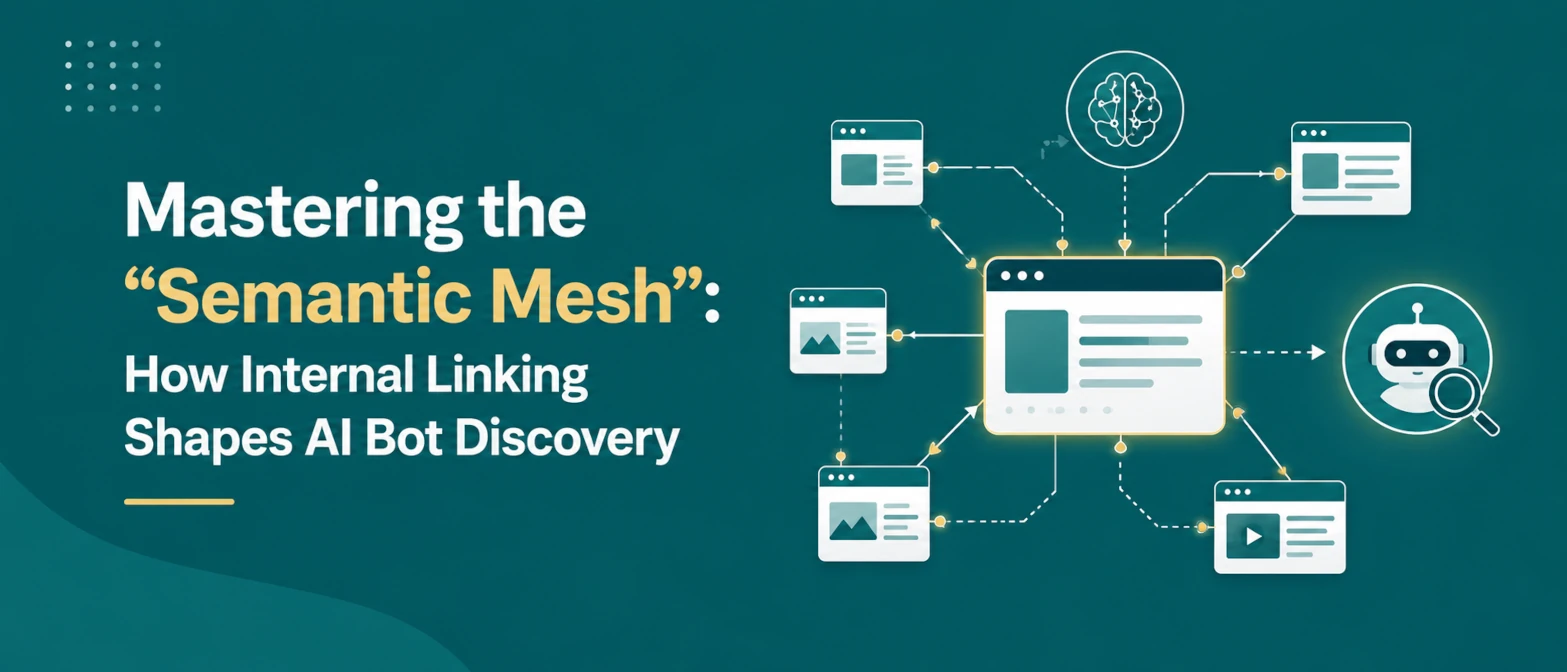
Internal linking used to be treated as simple navigation support. In AI-driven search experiences, it now acts as a semantic routing layer that helps systems understand how your knowledge is structured. If pages are isolated, AI systems may treat them as low-context fragments. If pages are connected with precise intent, your domain appears as a coherent topic authority.
This guide explains how to build a semantic mesh for 2026 search behavior, where AI Mode and AI Overviews rely on broad context retrieval and multi-hop reasoning. The objective is not keyword stuffing. The objective is structured discoverability and useful navigation for both people and machines.
Short answer
A semantic mesh is an internal linking strategy that connects related guides, tools, and reference pages using context-rich anchors and clear hierarchy. It improves discovery, topical authority signals, and user flow depth. In AI search environments, this structure increases your chances of being selected as a supporting source.
Why this matters after Google I/O 2026
Google announced major AI search expansion on May 19, 2026. AI-powered answers rely on broad retrieval across subtopics. Sites with better contextual architecture are easier to parse and cite. That means internal link quality is now part of citation readiness, not just old-school crawl management.
Flat linking vs semantic mesh
| Pattern | Behavior | Impact |
|---|---|---|
| Flat linking | Random related links and generic anchors | Weak concept mapping and shallow traversal |
| Semantic mesh | Intent-based clusters with specific anchors | Clear topical graph and stronger discovery |
Core components of a semantic mesh
- Pillar pages: broad guides that define category scope.
- Support pages: deep pages for exact tasks and edge cases.
- Tool-to-guide links: practical next-step paths after task completion.
- Guide-to-tool links: immediate execution routes for readers.
- Anchor precision: descriptive links that explain destination intent.
Implementation framework
- Map topic clusters: group pages by user task, not by publication date.
- Fix orphan pages: ensure every priority page has inbound contextual links.
- Standardize anchors: replace vague anchors like "click here" with intent phrases.
- Add bidirectional links: connect guide pages back to relevant tools and hubs.
- Review monthly: update mesh when new guides and tools are published.
Examples
1. Image performance cluster
Link WebP comparison guides to converter tools, compressor workflows, and resize playbooks. This creates a complete path from decision to execution.
2. JSON operations cluster
Connect JSON formatter, schema validator, JSON-to-CSV workflow, and security guides to cover implementation and risk control in one graph.
3. SEO operations cluster
Join sitemap, robots, internal linking, and schema guides with corresponding generators to support both strategy and execution.
Common linking mistakes
- Over-linking every paragraph regardless of context.
- Using identical anchor text for unrelated destinations.
- Linking only from new posts while leaving old hubs stale.
- Ignoring mobile readability with dense link blocks.
Measurement checklist
- Orphan page count
- Average internal links per key page
- Depth to reach tool pages from blog hubs
- Session continuation from guide to tool interactions
Editorial governance for semantic mesh maintenance
A mesh degrades over time if governance is missing. Add a lightweight editorial process:
- Each new blog must link to at least three relevant tool or guide pages.
- Each updated tool must reference current best-practice guides where useful.
- Quarterly audits must remove broken links and stale references.
- Anchor text should reflect task intent, not generic navigation language.
This governance keeps topical clusters healthy as content grows.
How to measure mesh quality in analytics
- Guide-to-tool clickthrough: are readers moving from education to execution?
- Average pages per session: does internal routing increase depth?
- Exit rate by cluster: where does the flow break?
- Coverage score: what percentage of key pages have bidirectional links?
Use these metrics to prioritize updates where user flow and discovery are weakest.
Upgrade plan for older archives
Older posts often drive stable traffic but contain outdated or minimal linking. Build an archive update sprint:
- Re-map top legacy posts to current tool routes.
- Add concise "next step" sections near conclusion blocks.
- Replace obsolete links with canonical categorized URLs.
- Re-run internal link audit and confirm zero orphan pages in priority clusters.
This can deliver faster gains than publishing new standalone posts.
TryFormatter tools for mesh building
Architecture and discovery workflow
Frequently asked questions
There is no fixed number. Add links where they provide real next-step value and context expansion.
No. It improves user navigation, crawl efficiency, and topical clarity for classic search too.
Yes. Updating existing high-traffic posts is often faster and more effective than publishing isolated new posts.
No. Linking strengthens discoverability, but source pages still need clear, useful, people-first depth.
Conclusion
A semantic mesh turns scattered pages into an understandable knowledge system. In 2026 search environments, that structure is essential for both user success and AI citation visibility.