
AI Search vs Traditional SEO: What Actually Matters in 2026
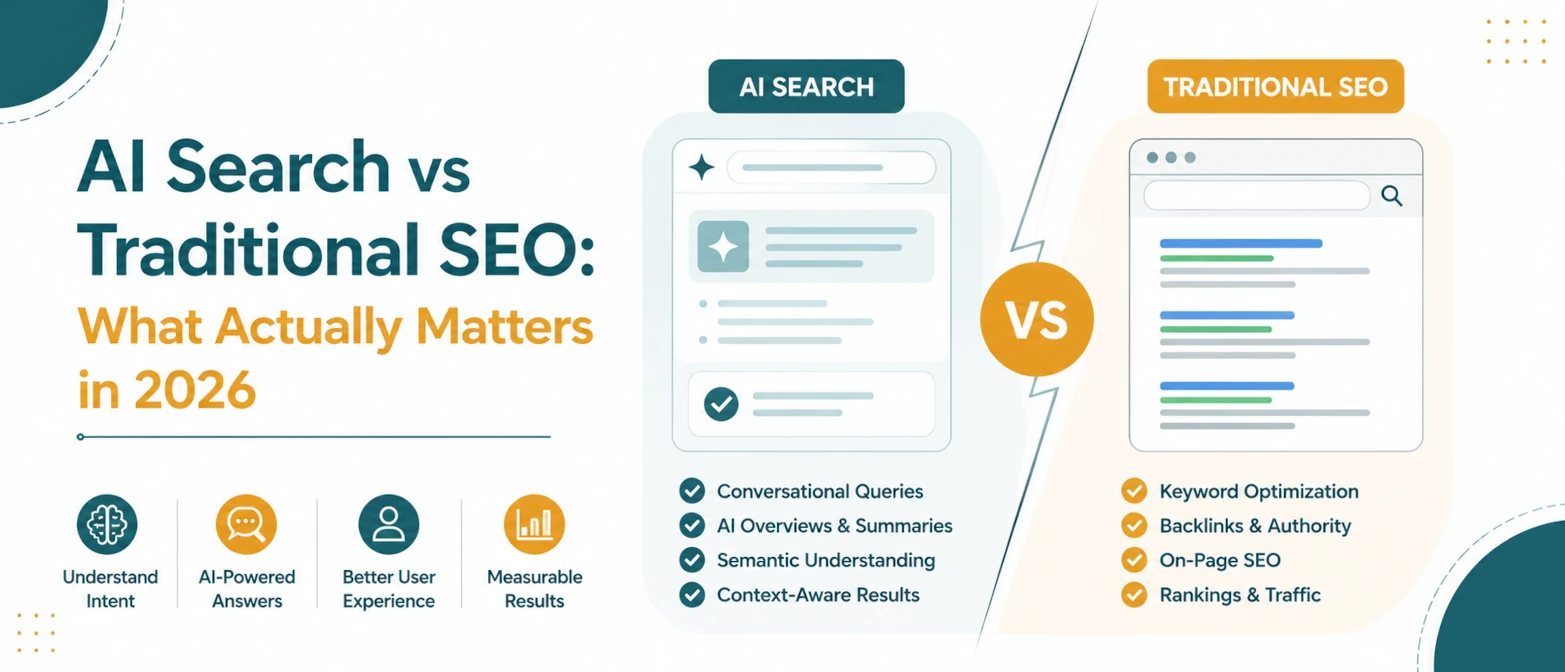
Search is no longer only a list of ten blue links. In 2026, many users see AI Overviews, AI Mode, chat answers, summaries, citations, and follow-up questions before they click a website. That does not mean traditional SEO is dead. It means the job has become wider.
The best way to think about it is simple: traditional SEO helps search engines find, crawl, understand, and rank your page. AI search also needs those basics, but it looks harder for clear answers, useful examples, trusted context, and source-worthy sections that can be cited inside a generated answer.
Short Answer
In 2026, traditional SEO still matters because AI search depends on crawlable, useful pages. What changed is that pages now need answer-ready sections, examples, FAQs, and clear source signals so AI systems can summarize and cite them. You should not choose between SEO and AI search optimization. You should build pages that work for both.
What Traditional SEO Still Does Well
Traditional SEO is the foundation. If a page cannot be crawled, indexed, or understood, it has very little chance of appearing in normal search results or AI search features. The core work is still important:
- Use clear titles and meta descriptions.
- Keep pages fast and mobile friendly.
- Write helpful content for real users.
- Use internal links to connect related pages.
- Make sure search engines can crawl important URLs.
- Use structured data only when it matches visible page content.
These basics are not old-fashioned. Google's own guidance for AI features says normal SEO best practices remain relevant for AI Overviews and AI Mode. The difference is that the page now needs to be easier to extract from, not just easier to rank.
What AI Search Changes
AI search changes how answers are shown. Instead of sending every user to a list of pages, the search system may create a summary from several sources. A user may get an answer, ask a follow-up question, and only click one or two cited pages.
That makes three things more important:
- Answer clarity: the page should answer the main question early.
- Source quality: the page should include examples, facts, tables, and practical details.
- Trust signals: the page should show authorship, update context, internal links, and honest limitations.
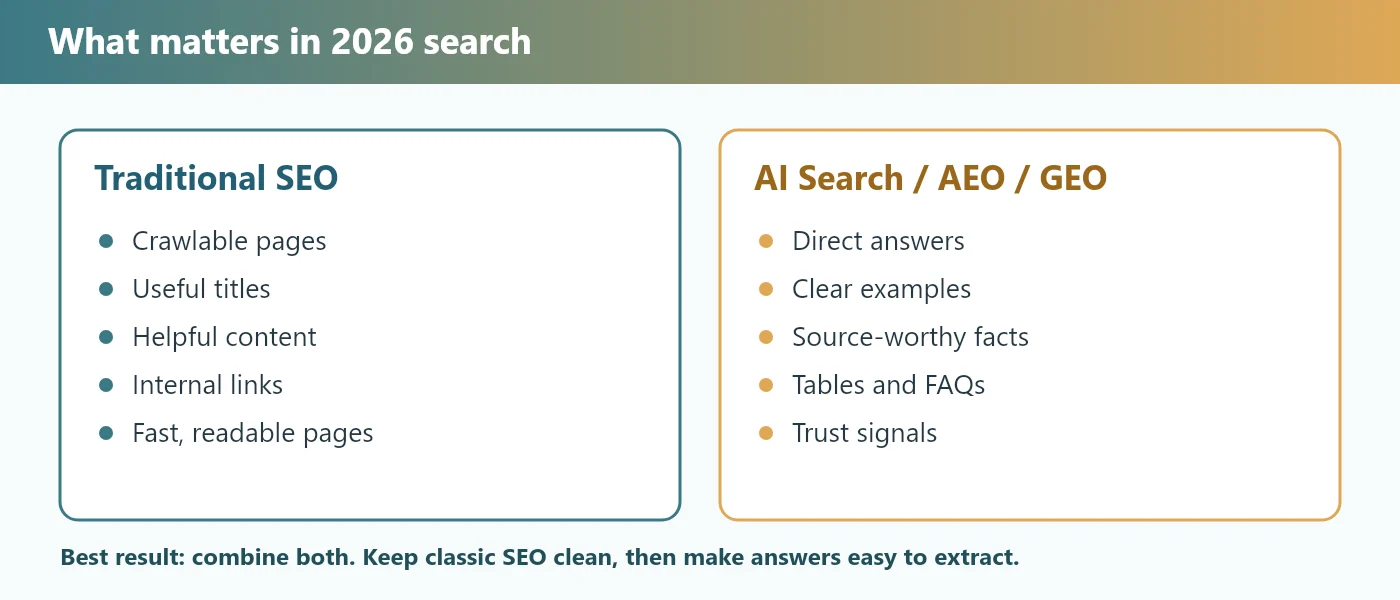
SEO vs AEO vs GEO in Simple Words
The terms can sound confusing, but the work is practical:
| Term | Simple Meaning | What to Do |
|---|---|---|
| SEO | Help search engines find and rank your page. | Fix crawl, titles, links, page speed, and useful content. |
| AEO | Help answer engines understand direct answers. | Add short answers, FAQs, and step-by-step sections. |
| GEO | Help generative AI systems summarize and cite your content. | Add examples, tables, original context, and clear source sections. |
These are not three separate jobs. A strong page usually does all three. It is crawlable, useful, and easy to quote.
What Actually Matters in 2026
The most important work is not chasing every new search feature. Focus on the things that repeatedly help both normal search and AI search.
1. Clear Page Intent
Each page should solve one main problem. If a page tries to answer too many unrelated questions, AI systems may struggle to identify the best passage to cite. A page about "AI Search vs Traditional SEO" should explain the difference, show what matters now, and give a practical checklist. It should not drift into unrelated marketing advice.
2. Direct Answers Near the Top
Put the short answer early. This helps users who want a quick explanation and helps AI systems find the core idea. A good short answer is not a slogan. It is a complete answer in plain words.
3. Specific Examples
Generic advice is weak. Examples make a page more useful. For example, instead of saying "use schema," explain which schema fits which page type. Instead of saying "write better content," show a good answer block or comparison table.
4. Crawl and Index Hygiene
AI search still needs access to your content. Check robots.txt, canonical URLs, sitemap inclusion, status codes, and internal links. Use tools like the XML Sitemap Generator, Robots.txt Generator, and SEO Audit Tool to review technical signals.
5. Trust and Update Signals
Search systems need to decide whether a page is reliable enough to show. Trust signals include author information, accurate dates, useful internal links, clear examples, and content that does not make claims it cannot support.
Practical Page Structure
A search-friendly and AI-friendly article can use this structure:
- Title that names the exact topic.
- Short intro that explains the problem.
- Short answer section in the first part of the page.
- Comparison table or checklist.
- Step-by-step advice with examples.
- Relevant internal links to tools or supporting guides.
- FAQ section with direct answers.
- Official references when the topic depends on platform guidance.
Measurement Is Different Now
Traditional SEO measurement often focused on rankings, impressions, clicks, and click-through rate. Those still matter, but AI search makes the picture less direct. A user may see your brand or page cited without clicking. Another user may ask a follow-up question and click later.
Track a wider set of signals:
- Search Console impressions and queries.
- Clicks from long-tail questions.
- Pages that earn citations or mentions in AI answers.
- Engagement on pages with clear answer sections.
- Internal clicks from guides to related tools.
Do not treat one metric as the whole truth. In 2026, search visibility is spread across classic results, AI summaries, citations, and assistant-style experiences.
Common Mistakes
- Writing only for keywords: Pages still need useful answers and examples.
- Ignoring technical SEO: AI search does not fix crawl or indexing problems.
- Using fake FAQ sections: FAQs should answer real questions, not repeat keywords.
- Publishing thin AI content: Long content is not enough if it lacks original examples.
- Forgetting internal links: Related tools and guides help users and search systems understand context.
Useful TryFormatter Tools
Use these browser-native tools to check and improve pages without uploading private drafts or internal site data:
SEO and AI search workflow
Official References
Use official documentation when making search decisions. Google says best practices for SEO remain relevant for AI features in Search, and its helpful content guidance still focuses on people-first content.
- Google Search Central: AI features and your website
- Google Search Central: Creating helpful, reliable, people-first content
- Google Search Central: SEO Starter Guide
Frequently Asked Questions
No. Traditional SEO is still the base layer. AI search still depends on crawlable pages, helpful content, clear titles, internal links, and clean technical signals.
The biggest change is answer extraction. Pages need clear passages, examples, and context that AI systems can summarize and cite.
No. Add an FAQ only when there are real questions users ask. A forced FAQ can make a page look repetitive and less useful.
Start with important pages that already get impressions. Add a short answer, improve headings, add examples, check crawl signals, and connect the page to related tools or guides.
Conclusion
AI search does not replace traditional SEO. It raises the standard for clarity. In 2026, the strongest pages are easy to crawl, easy to understand, and easy to cite. Keep the SEO basics clean, then write pages with direct answers, useful examples, and trustworthy context.