
Google I/O 2026 Search Update: AI Mode, Agents, and the Publisher Playbook
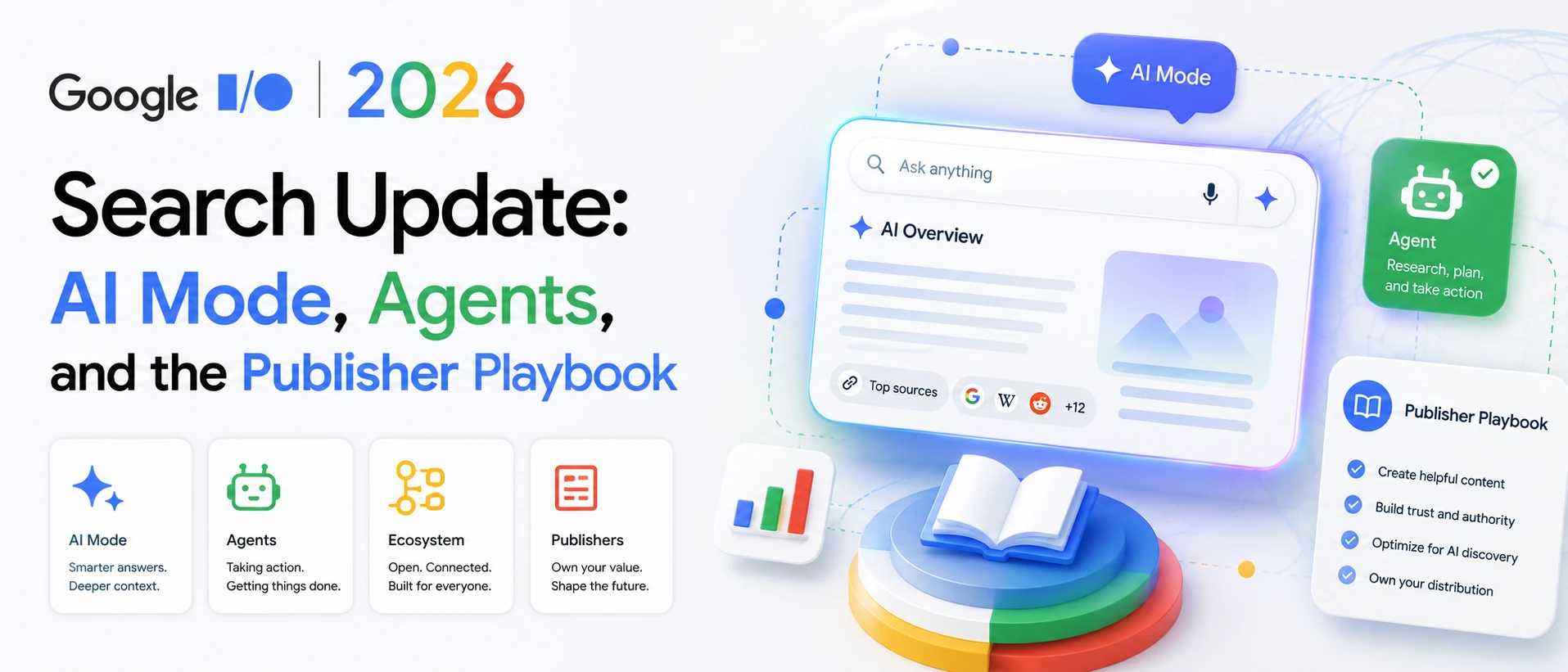
On May 19, 2026, Google announced a major Search update at Google I/O that pushes AI Mode deeper into everyday search behavior. The shift is not only about summaries. It is about how users complete tasks directly from conversational search flows and how sources are selected for citation.
If you run a tool website, documentation hub, SaaS blog, or technical content business, this matters immediately. The old SEO model assumed users would open several blue links and compare pages manually. The new model often starts with a synthesized answer and only then shows a small set of follow-up sources or actions.
This guide explains what changed, what did not change, and what you should do this week. It is designed as a practical implementation playbook, not a trend summary.
Short Answer
Google Search in 2026 is moving from link-first exploration to answer-first and action-first journeys. To stay visible, your pages must be citation-ready: clear answer blocks, strong structured data, high-trust signals, and tool pages that solve the next step instantly. Ranking still matters, but citation eligibility and task completion relevance matter more than before.
What Google announced on May 19, 2026
Google highlighted broader AI Mode usage, stronger model integration in Search experiences, and agent-like capabilities that can help users move from question to action. In plain terms, users can spend more time inside AI-driven interfaces and less time opening many websites for simple questions.
For publishers, the important point is not the demo itself. The important point is source selection pressure. When AI answers are generated, only a limited set of pages are surfaced as supporting references. If your page is hard to parse or slow to answer, it is easier to skip.
What did not change
Many teams overreact to announcements and rebuild everything. Do not do that. Core fundamentals are still valid:
- Crawlability still matters: If bots cannot fetch and parse pages reliably, nothing else helps.
- Content quality still matters: Thin, generic pages remain weak in both classic and AI-driven surfaces.
- Technical health still matters: Slow pages, broken canonicals, and inconsistent metadata still reduce trust.
- Internal linking still matters: Topic clusters still help systems understand authority depth.
What changed for practical SEO workflows
The biggest change is workflow order. Users increasingly see summarized answers first and only click when they need deeper detail, verification, or execution. That means your content must support both of these phases:
- Eligibility phase: Can AI systems trust and cite your page?
- Conversion phase: Once cited, does your page solve the next action quickly?
If your page is “informative but vague,” it can lose both phases. If your page is “clear, structured, and immediately useful,” it can win both phases.
Publisher playbook: what to implement this week
1. Add answer-first blocks above the fold
Every high-value page should include a short direct answer within the first screen view. Put the plain answer first, then details. This helps AI extraction and helps human scanning.
2. Tighten schema and visible-page alignment
Use structured data that exactly matches visible content. Do not inject inflated schema claims. For blog pages, use Article or BlogPosting. For tools, use the appropriate software/tool schema pattern and keep fields consistent with what users can actually do on the page.
3. Strengthen citation-friendly heading structure
Use specific H2 sections that answer one question each. Avoid decorative headings that hide intent. AI systems rely on section-level extraction, so predictable heading logic increases reuse probability.
4. Expand evidence in your “money pages”
Add concrete examples, edge cases, and constraints. Generic content is easy to replace by generated text. Evidence-rich content is harder to replace and more likely to be cited for reliability.
5. Improve internal semantic routing
Connect each blog post to relevant tools and each tool to relevant guides. This builds a semantic mesh that signals topical depth. Keep links contextual, not random.
6. Audit snippet integrity monthly
Check whether your top queries are appearing with accurate citation context in AI surfaces. If important sections are being misread, simplify phrasing, clarify table labels, and reduce ambiguous language.
7. Keep privacy and trust language explicit
For developer tools, state processing behavior clearly. Users and AI systems both reward trust clarity. If your tool runs in-browser with no upload, say it plainly near the top and near the CTA.
Page template pattern that works better in 2026
Use this structure for new high-priority pages:
- H1: Exact task intent.
- Short answer: 2-4 sentences, plain language.
- How to use: Numbered steps.
- Examples: Input/output or scenario/result.
- Limits and edge cases: What it cannot do.
- FAQ: Specific to actual workflow.
- Related tools/guides: Next action paths.
This format serves both classic users and AI retrieval systems. It is simple, repeatable, and measurable.
How this impacts tool websites specifically
Tool websites have one major advantage in AI search: executable value. AI can summarize what a JSON formatter is, but it cannot replace the user’s need to actually format private data safely in a browser. The same is true for converters, validators, and analyzers.
To use this advantage well:
- Keep tool UI fast and uncluttered on mobile.
- Keep privacy claims visible near the editor area.
- Include realistic sample data and immediate output feedback.
- Attach high-quality explanatory content below the tool.
Common mistakes after AI-search announcements
- Chasing buzzwords: Rewriting everything around “agentic” language without improving page clarity.
- Over-automating content: Publishing large volumes of thin AI text with no examples or original insight.
- Ignoring mobile readability: Dense layouts still lose conversions even if cited.
- Treating metadata as the whole strategy: Titles and descriptions help discovery but do not replace page quality.
- Skipping internal updates: Old pages with outdated headings and broken cross-links drag down authority.
30-day execution checklist
- Identify top 20 pages by business impact.
- Add or revise short-answer sections on all 20.
- Standardize heading hierarchy and FAQ specificity.
- Validate schema/page parity on each page.
- Add 3 to 5 contextual internal links per page.
- Improve one example block per page with real data.
- Review mobile rendering and fix overflow issues.
- Track citation visibility and click quality trends weekly.
TryFormatter tools for this rollout
Build AI-Ready Pages Faster
External references
- Google Search I/O 2026 updates (official)
- Google AI Mode and AI Overviews explainer (official)
- Bing Search Blog (official)
Frequently asked questions
No. You should write better long-form content with clearer structure and stronger evidence. AI systems still need reliable source material, and high-intent users still click for depth and execution.
No. Smaller sites can move faster. If your pages are clear, specific, and technically clean, you can compete well in citation-driven surfaces.
Add direct short-answer sections and improve heading structure on your highest-impact pages. That single change often improves both human scanning and machine extraction quality.
Conclusion
The May 19, 2026 Search update is not the end of SEO. It is a change in interface and selection logic. Teams that focus on clear answers, structured trust signals, and real task completion will keep winning visibility.
Do not optimize for hype cycles. Optimize for clarity, usefulness, and verifiable value. That is still the most stable strategy in AI search.