
How to Make Your Website AI-Citable in 2026
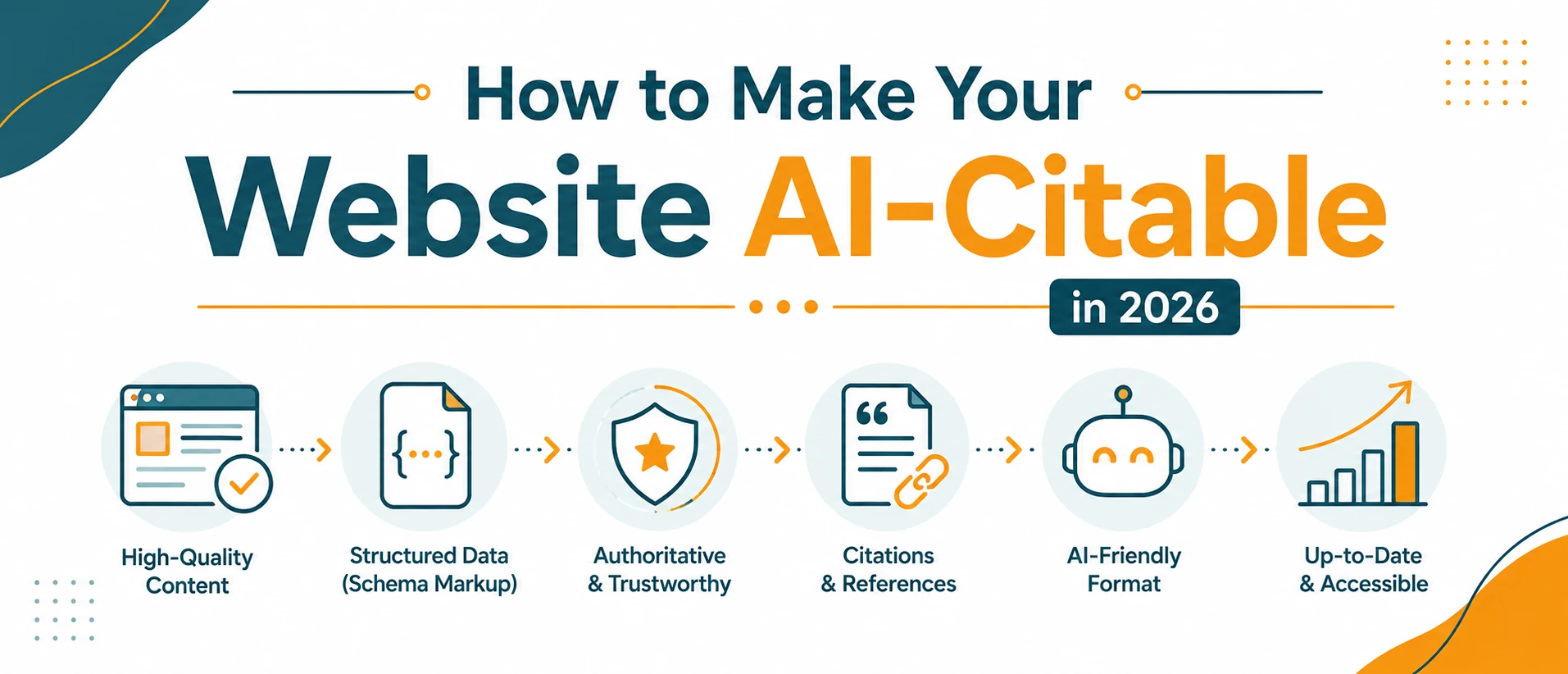
A practical implementation guide for improving your website's visibility in AI-powered search systems such as ChatGPT, Google AI Overviews, Gemini, Claude, and Perplexity in 2026.
The internet is undergoing its most profound transformation since the dawn of the web browser. For nearly three decades, website optimization followed a singular paradigm: write content for humans, insert keywords for crawlers, and optimize for ranking position. The goal was to secure a spot in the "ten blue links" of search engine result pages (SERPs) so a human visitor would click through and read your page.
In 2026, this model has shifted. Today, a massive share of web queries is answered directly inside generative environments. ChatGPT, Gemini, Google AI Overviews, Claude, and Perplexity do not just direct users to websites—they digest search queries, crawl the web, synthesize multiple sources, and present a complete generated answer. The traditional concept of a "click-through" has been replaced by the "citation."
To survive and thrive in this new landscape, your site must become AI-citable. This means structuring your HTML, metadata, schemas, and content delivery so that LLM crawlers can easily ingest your facts, attribute them to your domain, and confidently reference your URL as a source. In this guide, you will learn the exact technical checklist, semantic markup patterns, and structured data standards required to optimize your site for generative search engines in 2026.
What Does AI-Citable Mean?
Being "AI-citable" is the process of making your website's facts, statistics, definitions, and tutorials instantly recognizable, machine-consumable, and authoritative for LLM-based crawlers. When an AI answer engine synthesizes an answer for a user, it actively scores available web documents on relevance, structure, and trustworthiness. An AI-citable website provides answers with such extreme clarity and structural integrity that the LLM engine can directly extract the content and append a citation link to the user's generated response.
To achieve this, AI systems look for content that exhibits the following characteristics:
- Well-Structured: Utilizing clean hierarchical heading tags (H1 to H6) and semantic block-level structures.
- Easy to Parse: Free of heavy rendering blocks, client-side execution dependencies, or chaotic nesting.
- Trustworthy: Backed by verified author bios, stable canonical URLs, and cryptographically valid data schemas.
- Consistent: Maintaining uniform terminology, standard data formats, and logical structural relationships.
- Rich in Context: Supplying deep relational connections through JSON-LD entities and contextual hyperlinks.
- Supported by Metadata: Furnishing explicit meta fields that define dates, page intents, and indexing guidelines.
To illustrate the difference in optimization targets, consider how traditional search parameters compare to generative AI search variables:
| Traditional Search | AI Search |
|---|---|
| Links: Focuses on ranking lists of URLs. | Answers: Focuses on synthesizing direct conversational responses. |
| Keywords: Targets literal phrases and exact matches. | Context: Relies on semantic intent and entity extraction. |
| Ranking: Measures authority primarily via backlink volume. | Citation: Earns traffic through explicit factual references. |
| HTML: Parsed mainly for keyword placement and visual hierarchy. | Structured Data: Requires explicit JSON-LD schema to verify facts. |
| Metadata Optional: Descriptions used mainly to influence visual snippet CTR. | Metadata Important: Meta fields used by crawlers to determine page relevance. |
How AI Systems Read Your Website
AI systems do not browse your site like a human user, nor do they crawl it exactly like legacy indexers. When an AI agent (such as OpenAI's GPTBot or Anthropic's ClaudeBot) crawls your domain, it executes a multi-step semantic parsing lifecycle to digest your content efficiently:
Website
  ↓
Crawler (GPTBot, ClaudeBot, Google-Extended)
  ↓
HTML (Raw DOM parsing, stripping visual CSS)
  ↓
Structured Data (JSON-LD verification and validation)
  ↓
Metadata (Extracting tags, author, date, and canonical)
  ↓
Content Extraction (Segmenting headers, lists, and tables)
  ↓
Knowledge Graph Integration (Entity relation matching)
  ↓
Generated Answer (Formulating direct citation-ready responses)
During this parsing process, the crawler analyzes several structural layers:
- HTML structure: Evaluates the purity of semantic tags. A clean DOM is far easier to convert into text chunks than one loaded with empty container divs.
- JSON-LD: Acts as the database record of your page, defining exactly what entities are on the page.
- Open Graph & Canonical Tags: Establish the definitive URL to associate with any generated citations.
- Robots.txt & Sitemap: Instruct the bot on crawl limits, sitemap index locations, and update frequencies.
- Headings & Semantic Links: Provide pathfinding cues that define how topics are logically grouped and referenced.
Why Some Websites Get Cited More Often
AI systems are programmed with strict guardrails to minimize "hallucinations"—the generation of false or unverified facts. When an LLM search engine generates a response, it pulls data chunks from domains that have a high Confidence Score. Certain content characteristics naturally yield higher confidence scores and earn more citations:
- Clear Headings: Using straightforward, question-focused subheaders that match user query intent.
- Original Research: Providing unique data points, custom surveys, and primary source research.
- Step-by-Step Guides: Offering numbered instructions that can be easily parsed into sequential steps.
- Precise Definitions: Giving explicit, single-sentence definitions of complex industry concepts.
- Clean Tables: Delivering structured data points in standard tabular format rather than dense prose paragraphs.
- Structured FAQs: Supplying concise Q&A pairings that can be directly mapped to user queries.
- Good Page Experience: Rendering pages quickly with minimal layout shift so crawlers can easily complete ingestion.
Build an AI-Friendly Information Architecture
To help AI systems map your website's knowledge effectively, you must establish a clear, logical information architecture. This involves organizing your directory paths and linking them systematically.
1. Logical URL Structure
Use a hierarchical directory structure that separates your resources cleanly. This helps bots immediately categorize the content type. For example:
/blog/for informational articles and industry guides./tools/for interactive scripts and calculators./guides/for detailed technical manuals./docs/for public APIs and structured document resources.
2. Descriptive, Keyword-Rich URLs
AI bots use URL semantics to build high-level contextual predictions. Avoid numeric parameters or messy ID queries in favor of human-readable paths:
- Good:
https://www.tryformatter.com/blog/how-to-optimize-images-for-web-performance - Bad:
https://www.tryformatter.com/page?id=42&cat=img&ref=s5
3. Semantic Mesh Internal Linking
Create a structured link mesh that leads bots from high-level categories down to specific utility tools or guides. Avoid dead ends or disconnected pages:
Homepage
  ↓
AI Hub (Topic Pillar)
  ↓
Blog Article (Deep Insight)
  ↓
Interactive Tool (Functional Utility)
  ↓
Related Tools (Contextual Link Network)
Make Content Easy to Parse
To optimize for machine readability, write your content in a highly parseable layout. When text structures are standard and clean, LLM chunking algorithms can segment the page without losing context:
- One H1 Only: Ensure every page has exactly one H1 tag defining the primary subject.
- Logical H2/H3 Hierarchy: Structure subtopics sequentially. Never skip from an H2 straight to an H4.
- Structured Lists: Use ordered lists (
<ol>) for step-by-step processes and unordered lists (<ul>) for grouping features. - Factual Tables: Present comparisons and metrics in semantic tables. LLMs are excellent at reading CSV-like HTML structures.
- Definitions and Blockquotes: Highlight key definitions using semantic tags so they stand out as quote-worthy text snippets.
- Clean Code Blocks: Wrap programming code in formatted
<pre><code>elements to maintain indentations and symbols.
Structured Data That Helps AI
Structured data is the primary vehicle for transmitting verified facts directly to AI bots. By implementing Schema.org definitions in JSON-LD format, you translate human narrative into queryable entity properties. Here are three critical structured data patterns you should deploy:
1. Article Schema
Article schema defines the headline, author, publishing organization, and modification dates of your guides. This helps AI search engines display author credentials and verify freshness.
{
  "@context": "https://schema.org",
  "@type": "TechArticle",
  "headline": "How to Make Your Website AI-Citable in 2026",
  "image": "https://www.tryformatter.com/blogs/how-to-make-your-website-ai-citable-in-2026.webp",
  "author": {
    "@type": "Person",
    "name": "TryFormatter Team",
    "url": "https://www.tryformatter.com/about"
  },
  "publisher": {
    "@type": "Organization",
    "name": "TryFormatter",
    "logo": {
      "@type": "ImageObject",
      "url": "https://www.tryformatter.com/logo.png"
    }
  },
  "datePublished": "2026-06-26T21:30:00+05:30",
  "dateModified": "2026-06-26T21:30:00+05:30"
}
2. FAQ Schema
FAQ schema pairs specific questions with definitive answers. This is a high-yield configuration for earning direct citations in Perplexity and Google AI Overviews.
{
  "@context": "https://schema.org",
  "@type": "FAQPage",
  "mainEntity": [
    {
      "@type": "Question",
      "name": "What is an AI-citable website?",
      "acceptedAnswer": {
        "@type": "Answer",
        "text": "An AI-citable website is one optimized with semantic HTML, JSON-LD schema, and clear content structures that allow AI engines to easily read, verify, and reference its facts as active citations."
      }
    }
  ]
}
3. Breadcrumb Schema
Breadcrumb schema charts the location of your page in your site's hierarchy, helping AI models map relations within your topical cluster.
{
  "@context": "https://schema.org",
  "@type": "BreadcrumbList",
  "itemListElement": [
    {
      "@type": "ListItem",
      "position": 1,
      "name": "Home",
      "item": "https://www.tryformatter.com/"
    },
    {
      "@type": "ListItem",
      "position": 2,
      "name": "Blog",
      "item": "https://www.tryformatter.com/blog"
    },
    {
      "@type": "ListItem",
      "position": 3,
      "name": "AI-Citable Website Guide"
    }
  ]
}
Metadata Checklist
Before launching a new guide or tool, ensure your HTML <head> contains a complete metadata footprint. AI systems parse these meta tags during ingestion to establish authorship, dates, and canonical targets:
- Title: A clear, descriptive title tag under 60 characters. Avoid hyphens in favor of clean pipe characters (e.g.,
Title | TryFormatter). - Meta Description: A compelling, descriptive page summary between 120 and 155 characters that summarizes the core value.
- Canonical URL: The absolute URL of the page, ensuring you do not drop the
wwwprefix or introduce HTTP/HTTPS mismatches. - Open Graph Tags:
og:title,og:description,og:image, andog:typeto control exactly how the page visualizes when referenced. - Twitter Card:
twitter:card(preferably set tosummary_large_image) and handles. - Language and Charset: Define
lang="en"on the html element and<meta charset="utf-8">to prevent parsing translation errors. - Author: Define the author name using meta elements or schema to build topical expertise.
- Publication & Modification Dates: Supply exact timestamps to show freshness, which is highly prioritized by real-time AI agents.
- Keywords (Historical context): While largely ignored by traditional search indexers, meta keyword structures are sometimes parsed by LLM models for high-level semantic tag classification.
Create Content AI Can Quote
To help AI systems extract quotes and statistics directly from your website, design your layouts to be citation-friendly. Use formatting techniques that isolate key information:
- Authoritative Definitions: Place single-sentence definitions inside highlighted box containers.
- Step-by-Step Instructions: Use standard ordered lists with explicit classes (e.g.,
<ol class="howto-list">) to signal chronological instructions. - Comprehensive Tables: Avoid representing multi-dimensional data in paragraph blocks; format them into tables.
- Clear Comparisons: Use direct "Pros & Cons" bullet lists or side-by-side tables when analyzing alternative technologies.
- Original Visuals: Accompany your concepts with diagrams or screenshots. AI agents are increasingly multi-modal and ingest image alt text and visual features.
Publish Machine-Readable Assets
Traditional SEO focuses on delivering HTML to browsers. AI-driven SEO requires publishing machine-friendly endpoints that allow LLM engines to extract data in bulk without crawling your entire human-facing interface:
- XML Sitemap: Ensure your sitemaps are valid, correctly categorized, and updated immediately upon publication. You can audit sitemaps using our XML Validator.
- RSS Feed: Maintain a clean, structured RSS feed that broadcasts updates in XML format, allowing real-time AI indexers to query changes.
- robots.txt: Set clear crawl permissions for AI bots. You can block AI bots that scrape without giving citations (e.g., CCBot) while allowing friendly citation engines (e.g., GPTBot, OAI-SearchBot) using rules created with our Robots.txt Generator.
- llms.txt: Publish a root-level
llms.txtfile in markdown format. This standard serves as a high-level table of contents and documentation summary specifically designed for ingestion by LLMs. - JSON APIs: Offer public JSON endpoints for dense statistics or tools, allowing AI agents to query raw structured variables directly.
Optimize Technical Performance
Technical quality directly correlates with crawler accessibility. If your website is slow, heavy, or relies on complex scripts to display content, AI crawlers will time out or skip parsing your page elements to save processing time:
- Core Web Vitals: Maintain high ratings for LCP (Largest Contentful Paint), FID (First Input Delay), and CLS (Cumulative Layout Shift).
- Mobile Responsiveness: Ensure all pages load cleanly on mobile viewports. AI bots crawl primarily using mobile user-agent simulations.
- Fast HTML Delivery: Serve pre-rendered or statically compiled HTML. Server-side rendering (SSR) is far superior to client-side single-page applications for crawlers.
- Semantic DOM: Keep your DOM tree shallow and clean. Avoid unnecessary nested divs that complicate text extraction.
- Accessibility (A11y): Use proper ARIA attributes, semantic buttons, and explicit descriptive alt tags on all imagery.
- Compression: Implement modern text compression algorithms (Gzip or Brotli) and optimize assets locally before deployment.
Common Mistakes to Avoid
When optimizing your website for AI search visibility, check for these common developer mistakes that can make your site invisible to LLMs:
- ❌ JavaScript-Only Content: Building single-page applications that render content solely on the client side. Fast AI crawlers will not execute complex JS, leaving them with an empty page.
- ❌ Missing Headings: Failing to use hierarchical
<h2>and<h3>tags, which leaves the AI with an unorganized wall of text. - ❌ Broken Schema Syntax: Publishing JSON-LD with formatting errors like trailing commas or unescaped quotes. Always validate schemas with a tool.
- ❌ Duplicate Content: Maintaining multiple versions of the same article without canonical tags, which splits your confidence score.
- ❌ Infinite Scroll without Pagination: Hiding older articles or tools behind an infinite scroll button that crawlers cannot interact with.
- ❌ Missing Canonical URLs: Failing to explicitly specify the canonical URL, which can lead to crawlers indexing tracking parameters or wrong domains.
- ❌ No Sitemap: Relying on crawl discovery without supplying a structured map of your site's URLs.
- ❌ Thin Content: Publishing short, AI-generated filler articles that lack original research or unique insights.
AI-Citable Website Checklist
Use this technical checklist to audit your pages and verify that your domain is fully prepared for AI search citations:
- ☐ Semantic HTML: Verify that H1 to H3 tags are nested properly and only one H1 is active per route.
- ☐ Structured Data: Implement valid JSON-LD schema for Articles, Breadcrumbs, FAQs, and Organization tags.
- ☐ Metadata Validation: Check that canonical URLs include the absolute domain and correct HTTPS protocol.
- ☐ Internal Link Mapping: Build a cohesive semantic linking structure linking topics, guides, and tools.
- ☐ XML Sitemap Presence: Maintain a dynamic sitemap that updates automatically when new articles go live.
- ☐ Robots.txt Rules: Set specific access guidelines for search engines and AI crawlers.
- ☐ llms.txt Setup: Publish a root-level
llms.txtmarkdown file summarizing your documentation and site structure. - ☐ Tabular Data: Convert dense lists of statistics or metrics into standard HTML tables.
- ☐ Direct FAQ Q&As: Include concise, search-intent matching question and answer segments.
- ☐ Technical Auditing: Keep Core Web Vitals in the green and ensure server-rendered page assets load under 1 second.
The Future of AI Search
AI search is shifting from simple text matching to a complex, multi-modal network of autonomous agents. As this landscape evolves, look for these trends to guide your long-term technical strategy:
- Agentic Search: AI agents will perform deep research tasks, executing transactions, compiling long reports, and making purchases on behalf of users.
- Retrieval-Augmented Generation (RAG): Real-time retrieval pipelines will combine search queries with frozen model weights to deliver hyper-current responses.
- Machine-Readable APIs: Websites will serve optimized API endpoints specifically designed for consumption by AI agents.
- Verified Authorship: Cryptographic signatures and decentralized ID protocols will verify the human origin of content.
- Real-Time Indexing: Push-based indexing models will instantly update the knowledge base of LLM search engines.
- Multi-Modal Citations: AI engines will cite and reference images, video segments, data tables, and interactive software modules.
Related TryFormatter Tools
Optimizing your site's code, layouts, and data structures is much easier when you use the right tools. Use these browser-local utilities to format, validate, and convert your technical assets securely:
| Tool Name | Why It Helps | Link |
|---|---|---|
| JSON Formatter | Validate and beautify your JSON-LD schemas to catch syntax errors before publishing. | JSON Formatter |
| HTML Formatter | Format and clean up your HTML5 markup to ensure semantic clarity for LLM parsers. | HTML Formatter |
| XML Formatter | Inspect, beautify, and audit your sitemaps and XML feeds for structural mistakes. | XML Formatter |
| JSON Validator | Validate JSON schemas against industry standards, preventing broken structured data tags. | JSON Validator |
| HTML to Markdown | Convert clean semantic HTML articles into clean markdown, ideal for your llms.txt folder. | HTML to Markdown |
| XML Validator | Catch XML formatting bugs and syntax errors to verify that sitemaps are easily parsed. | XML Validator |
Frequently Asked Questions
What does AI-citable mean?
AI-citable describes a web page that is structured, annotated, and formatted so clearly that an AI search engine (such as ChatGPT, Claude, Perplexity, or Gemini) can easily extract, parse, verify, and reference its facts inside generated answers, crediting the original page with an active hyperlink.
Can ChatGPT cite my website?
Yes. When users run queries that require web search (utilizing search extensions or active web crawling), ChatGPT uses automated indexers to fetch current articles. If your site offers clean, semantic, and authoritative answers, ChatGPT will synthesize your data and output a citation link directly in the chat interface.
Does structured data guarantee AI citations?
No. Structured data does not guarantee that your page will be cited. However, it significantly increases your chances. Schema markup reduces semantic ambiguity, giving AI engines the high confidence they need to extract your facts and link back to your domain as a verified source.
Is schema markup enough to be AI-citable?
No. Schema markup is a critical component, but it must be paired with other optimizations. You need clear content hierarchies, descriptive subheadings, semantic HTML5 containers, authoritative answers to user intent, and high technical performance to ensure full accessibility.
Should I create an llms.txt file?
Yes, absolutely. The llms.txt file has rapidly become a standard for developers and webmasters in 2026. It serves as a lightweight, root-level markdown summary of your site's structure, allowing AI agents to quickly identify documentation directories and tool categories without scraping hundreds of pages.
Does page speed affect AI search?
Yes. AI crawlers operate with strict computational limits and timeouts. If a page takes several seconds to load or requires complex JavaScript to execute, AI bots may skip parsing the page to save processing time, which prevents your content from being cited in generative answers.
How often should I update metadata?
You should update metadata whenever you publish new material, refine existing guides, or add technical features. Real-time AI engines place a high premium on freshness, so ensuring your modification dates (via <lastmod> in sitemaps and modified fields in schema) are accurate is essential.
Can AI cite dynamic content?
Yes, but it is much more difficult. If your content is rendered dynamically in the browser using client-side JavaScript, AI crawlers may not wait for the scripts to execute. To ensure your dynamic data is cited, pre-render the pages on the server or serve static HTML snapshots.
Are PDFs AI-readable?
Yes, most AI engines can parse PDF documents. However, PDFs are much heavier and more difficult to traverse than clean HTML pages. For technical documentation or guides, publishing clean HTML5 web pages with structured JSON-LD schemas will yield much better visibility and more citations than PDF downloads.
What is the difference between SEO and AI optimization?
Traditional SEO optimizes for search engine rankings, search console clicks, and human CTR on SERPs, focusing on keyword density and backlink volume. AI search optimization (or GEO) optimizes for factual accuracy, semantic context, entity relationships, and machine readability, focusing on earning direct references inside conversational responses.
Conclusion
Becoming AI-citable in 2026 is not about trying to trick a specific machine learning algorithm or chasing temporary keyword trends. It is about building a durable, technical foundation that makes your website's knowledge easily readable and verifiable for both people and machine indexers. By treating structured data, clean semantic markup, fast load times, and structured information architecture as long-term developer investments rather than one-off marketing tasks, you position your domain to serve as an authoritative source in the generative search era.