
Machine-Readable Websites: The New SEO Checklist (2026 Guide)
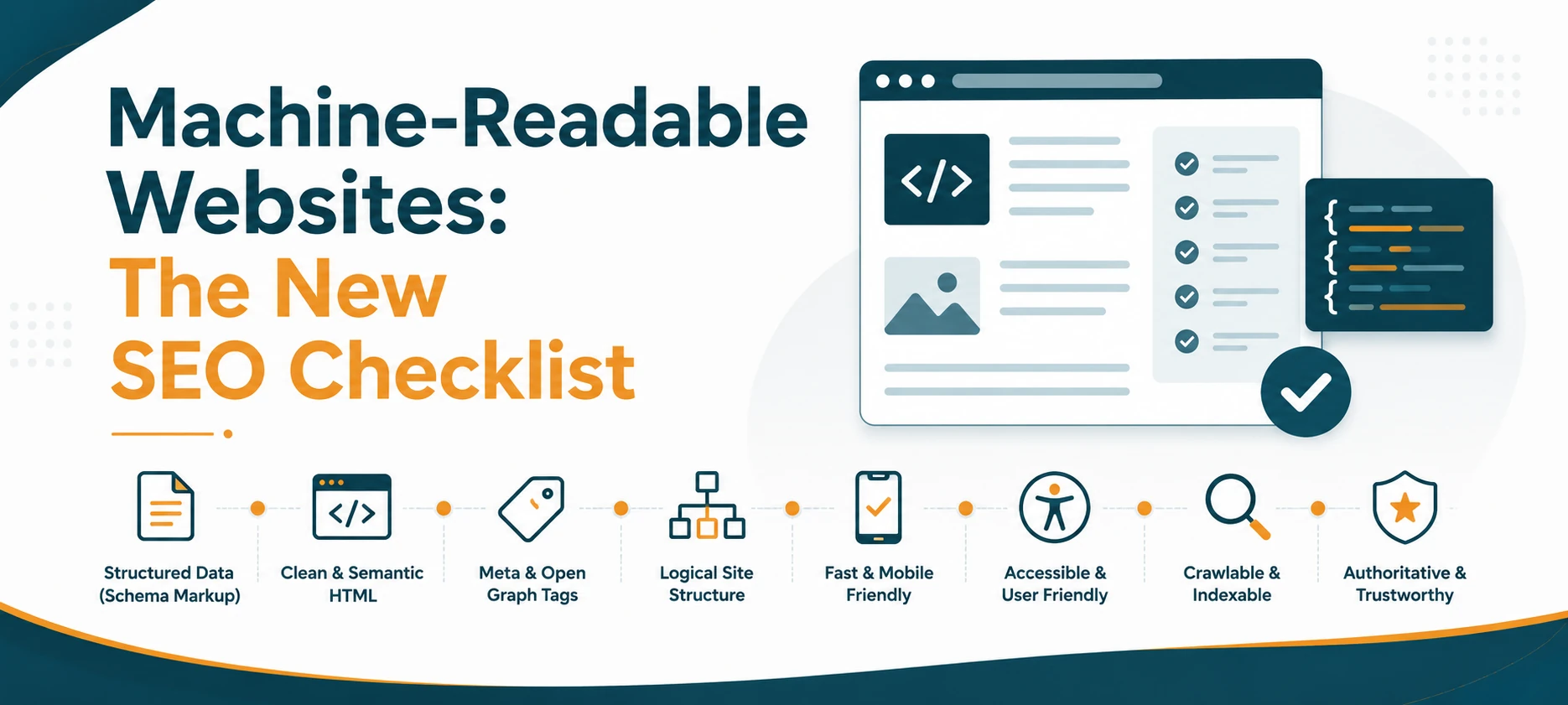
Search engines no longer simply index web pages—they interpret them. AI-powered search experiences such as ChatGPT, Google AI Overviews, Gemini, Claude, and Perplexity increasingly rely on structured, machine-readable information to understand content, generate answers, and recommend trustworthy sources.
A visually attractive website is still important, but appearance alone is no longer enough. Your content also needs to be easy for software to read, interpret, and organize.
This guide explains what makes a website machine-readable and provides a practical SEO checklist you can use to improve both traditional search visibility and AI discoverability.
What Is a Machine-Readable Website?
A machine-readable website presents information in a way that software systems can understand without guessing. Instead of only displaying content for people, the website also provides structure that computers can interpret.
Examples include:
- Semantic HTML
- Structured data (JSON-LD)
- XML sitemaps
- Metadata
- Clear heading hierarchy
- Descriptive URLs
- Internal linking
- Accessible markup
These elements reduce ambiguity and help search engines understand exactly what each page represents.
Why Machine Readability Matters in 2026
Traditional SEO focused on keywords, backlinks, PageRank, and meta tags. Modern AI search also evaluates context, content organization, relationships between pages, structured information, entity recognition, and trust signals.
When AI systems summarize information, they benefit from pages that clearly explain concepts rather than forcing algorithms to infer meaning.
Traditional SEO vs Machine-Readable SEO
| Traditional SEO | Machine-Readable SEO |
|---|---|
| Keywords | Structured information |
| Rankings | Understanding |
| Blue links | Generated answers |
| Metadata | Metadata + Schema |
| Crawl HTML | Interpret meaning |
| Link authority | Content clarity |
Modern websites need both approaches.
How AI Reads a Website
A simplified workflow looks like this:
Website
↓
HTML
↓
Semantic Structure
↓
Metadata
↓
Structured Data
↓
Internal Links
↓
Knowledge Extraction
↓
AI Response Generation
Each layer helps software understand your content with greater confidence.
The Complete Machine-Readable SEO Checklist
1. Use Semantic HTML
Avoid building pages entirely with generic <div> elements. Instead, use meaningful HTML elements:
<header>
<nav>
<main>
<article>
<section>
<aside>
<footer>
Semantic markup communicates the purpose of every section. This results in better accessibility, easier crawling, and a clear document structure.
2. Create a Proper Heading Hierarchy
A page should normally contain one H1, logical H2 sections, and supporting H3 headings. Avoid skipping heading levels unnecessarily.
H1
└── H2
    ├── H3
    └── H3
└── H2
    └── H3
3. Write Descriptive URLs
Descriptive URLs help both users and crawlers understand page intent. For example, use /blog/machine-readable-websites instead of /page?id=2847.
4. Add Structured Data
Structured data provides explicit meaning. Useful schema types include Article, FAQPage, BreadcrumbList, Organization, SoftwareApplication, WebSite, and SearchAction. JSON-LD remains Google's recommended implementation format.
5. Improve Metadata
Every page should include a unique title, meta description, canonical URL, Open Graph tags, Twitter Card, language attribute, author, and publish or update dates. Metadata improves content understanding across platforms.
6. Build a Logical Internal Link Structure
Every important page should connect naturally to related content. Internal links provide context and distribute authority throughout the site:
Homepage
↓
SEO Guides
↓
Machine Readable Websites
↓
Structured Data Guide
↓
JSON Formatter Tool
7. Publish XML Sitemaps
A sitemap helps search engines discover pages efficiently. Include blog posts, tools, documentation, and categories, and update it automatically whenever new content is published.
8. Maintain a Clean robots.txt
Your robots.txt should allow important pages, block unnecessary system directories, and reference your sitemap:
User-agent: *
Allow: /

Sitemap: https://www.tryformatter.com/sitemap.xml
9. Use Consistent Navigation
Navigation should remain predictable across the website. Avoid constantly changing menus or hiding important pages behind complex JavaScript interactions. Clear navigation improves crawl depth and user experience.
10. Create Helpful Content
Machine-readable does not mean robotic. Content should include definitions, examples, tables, checklists, step-by-step guides, images, code samples, and frequently asked questions. These formats are easier for both people and AI systems to understand.
11. Make Pages Fast
Performance remains important. Focus on image optimization, lazy loading, compression, browser caching, minified assets, and reduced JavaScript. Fast pages improve crawling efficiency and user satisfaction.
12. Optimize Images
Every image should include a descriptive filename (like machine-readable-seo-checklist.webp instead of IMG_4529.webp), alt text, appropriate dimensions, and modern formats like WebP or AVIF.
13. Publish Clear Contact Information
Trust matters. Include an About page, Contact page, Privacy Policy, and Terms of Service. These pages help establish website legitimacy.
14. Keep Content Updated
Search engines value freshness when appropriate. Regularly update screenshots, refresh statistics, improve examples, add new FAQs, and expand explanations. Refreshing existing content is often more effective than publishing dozens of short articles.
15. Ensure Accessibility
Accessibility improvements also improve machine readability. Examples include alt text, form labels, keyboard navigation, sufficient color contrast, and ARIA attributes where appropriate. Accessible websites are easier for software to interpret.
Common Machine-Readability Mistakes
Avoid these common issues:
- ❌ Missing H1
- ❌ Duplicate titles
- ❌ Broken schema
- ❌ Generic URLs
- ❌ Missing canonical tags
- ❌ JavaScript-only navigation
- ❌ Thin content
- ❌ Orphan pages
- ❌ No sitemap
- ❌ Poor internal linking
Practical Checklist
Before publishing a page, verify:
| Checklist Item | Status |
|---|---|
| Semantic HTML & One H1 | ☐ Verify structure |
| Logical Headings & Unique Title | ☐ Verify headings |
| Meta Description & Canonical URL | ☐ Verify metadata |
| Structured Data & Schema Validation | ☐ Verify JSON-LD |
| Internal Links & Image Alt Text | ☐ Verify content links |
| XML Sitemap & Robots.txt Inclusion | ☐ Verify discoverability |
| Fast Load Times & Mobile Responsive | ☐ Verify performance |
| HTTPS & Accessible Navigation | ☐ Verify security/access |
How TryFormatter Can Help
Building a machine-readable website often involves working with structured data and clean markup. TryFormatter provides browser-based tools that can help during development and content publishing, including:
- JSON Formatter for validating JSON-LD schema
- JSON Schema Validator for detecting syntax issues
- HTML Formatter for cleaning semantic HTML
- XML Sitemap Generator for generating sitemaps
- Markdown to HTML Converter for documentation workflows
Because these tools run locally in your browser, you can inspect and refine your content without uploading sensitive data.
Frequently Asked Questions
Is machine-readable SEO different from traditional SEO?
It complements traditional SEO rather than replacing it. Traditional ranking signals still matter, but clear structure and machine-readable content help search engines and AI systems interpret your pages more accurately.
Does structured data improve rankings?
Structured data does not guarantee higher rankings, but it helps search engines understand your content and may enable enhanced search features where applicable.
Do AI search engines use semantic HTML?
Semantic HTML provides meaningful structure that benefits accessibility and content interpretation. It is a recommended foundation for modern web development.
Should every page have schema markup?
Not every page requires the same schema type, but using appropriate structured data where it accurately represents the content is considered a good practice.
Does page speed still matter?
Yes. Fast-loading pages improve user experience, support efficient crawling, and remain an important aspect of technical SEO.
Are XML sitemaps still important?
Yes. They help search engines discover and prioritize important pages, especially on larger websites.
Conclusion
Machine-readable websites are becoming a core part of modern SEO. While great content remains essential, the way that content is structured now plays an equally important role in how search engines and AI systems understand it.
By using semantic HTML, structured data, descriptive metadata, logical navigation, and clear information architecture, you make it easier for both people and machines to discover, interpret, and trust your content.
Instead of treating machine readability as an advanced optimization, think of it as the foundation of every page you publish. A website that communicates clearly to software is also more likely to provide a better experience for human visitors, making it well positioned for the evolving landscape of AI-powered search.